

Direct Factory Catalog · Part I
Featured Industrial Thermal Systems & Elements
Engineered for extreme duty cycles, uniform thermal gradient control, and CE-compliant commercial execution across European, North American, and Asian industrial infrastructure.

CE Certification Precise Cooling and Heating System Manufacturers, Exporters
Product Specs
Best Heating/Cooling Integrated System Exporter, Exporters
Product Specs
CE Certification Flexible Heaters for Custom Applications Manufacturer, Exporter
Product Specs
Best Pipeline Heater Manufacturers, Factory
Product Specs
High-Quality Portable Ceramic Heaters for Industry
Product Specs
CE Certification Efficient Air Duct Heaters for HVAC
Product Specs
CE Certification Fan Manufacturer, Factory
Product Specs
Technical Whitepaper · Microstructure Science
The Engineering Shift to Printed Thick Film Technology
Transitioning from conventional wire-wound elements to sub-millimeter multi-layer dielectric screen printing: unlocking 60–100 W/cm² power densities and >97% thermodynamic conversion efficiency.
Thermodynamic Mechanics: Eradicating Thermal Latency
Traditional industrial heating architectures rely on mineral-insulated magnesium oxide (MgO) jackets, cast alloys, or wound mica substrates. These legacy architectures feature substantial thermal mass, creating dramatic thermal lag, steady-state overshoot, and delayed cooldown responses. Printed Thick Film Heating Elements (TFHE) fundamentally reshape this dynamic through micro-layer additive screen deposition directly onto dielectric-insulated stainless steel (AISI 430/304), alumina (Al₂O₃), aluminum nitride (AlN), or quartz substrates.
With dielectric film layers measuring under 150 µm and ruthenium-based resistive traces sintered between 850°C and 900°C, the thermal interface resistance approaches theoretical limits. This yields instant ramp speeds exceeding 80°C to 150°C per second, empowering closed-loop PID microcontrollers to govern thermal boundaries with ±0.5°C repeatability.
CE Certification Matrix
CE conformity under European Directives demands comprehensive validation beyond functional continuity:
- LVD 2014/35/EU: Hi-pot breakdown withstand (>1500V to 3750V AC).
- EMC 2014/30/EU: Low electromagnetic radiation during PWM duty cycles.
- EN 60335-1 & -2-15: Leakage current threshold maintained under <0.25 mA.
- RoHS & REACH: 100% lead-free, cadmium-free paste matrix.
>97%
Thermal Transfer Efficiency
150°C/s
Peak Ramp-Up Velocity
60-100
W/cm² Surface Power Density
<0.25mA
Cold Leakage Current Baseline
OEM & Tier-1 Procurement Criteria
Comprehensive Engineering Specification Matrix
Detailed comparative evaluation illustrating why multinational procurement engineers specify Thick Film technology over conventional mica, cast-in, and ceramic configurations.
| Performance Parameter | Printed Thick Film (Kangpu) | Mica Band Heaters | Ceramic Band Heaters | Cast-In Aluminum Elements |
|---|---|---|---|---|
| Operating Watt Density | 30 – 100 W/cm² | 2.5 – 4.5 W/cm² | 5.0 – 8.0 W/cm² | 3.0 – 6.0 W/cm² |
| Thermal Response Velocity | Instant (< 2-3 sec) | Moderate (30-90 sec) | Slow (180-300 sec) | Very Slow (Lag due to mass) |
| Dielectric Strength (Hi-Pot) | 1500V – 3750V AC / 50Hz | 1000V – 1250V AC | 1500V – 2000V AC | 1500V AC |
| Operating Life (MTBF) | > 15,000 Hours Continuous | 3,000 – 6,000 Hours | 8,000 – 12,000 Hours | 10,000 – 14,000 Hours |
| Integrated Sensing Profile | Direct Screen-Printed NTC / PT1000 | External Clamped Probe | External Insertion Thermocouple | Cast-in Thermocouple Well |
| Dimensional Profile Thickness | 0.8 mm – 2.0 mm | 3.5 mm – 5.0 mm | 10 mm – 15 mm | 18 mm – 35 mm |
Factory 4.0 · Yancheng Precision Cluster
China Industry 4.0: Supply Chain Resilience & Manufacturing Efficiency
Operating from our intelligent manufacturing campus in Jiangsu, China, Kangpu leverages fully automated screen deposition, precision micro-laser trimming, and 100% digitalized quality gates.
Class 10,000 Cleanroom Deposition
Particulate contamination is the leading cause of micro-fissuring and localized dielectric breakdown in thick film applications. Our cleanroom facilities employ automated optical registration screen printers that maintain alignment tolerances within ±5 µm across multiple dielectric, resistive, and glass-ceramic protective passes.
Dynamic Laser Trimming & Sintering
Utilizing computer-controlled YAG and fiber laser active resistance trimming, each thick film circuit is balanced in real time to within ±1.0% of nominal resistance. Our multi-zone infrared belt furnaces feature an 850°C peak sintering curve with micro-gradient stability of ±1.5°C across the full belt width.
End-to-End Batch Traceability
Every component manufactured leaves our line laser-engraved with an immutable 2D Data Matrix code. This links raw paste composition lots, sintering thermal graphs, hi-pot test metrics, and cold leakage ratings back to individual production logs, guaranteeing total reliability across our 5-year warranty period.
Application Engineering
Mission-Critical Commercial & Industrial Deployments
From cutting-edge e-Mobility 800V architectures to hemodialysis life-support equipment, Kangpu CE-certified printed thick film solutions provide uncompromised thermal security.
Electric Vehicle (EV) Thermal Management
Integrated within high-voltage 400V/800V powertrain architectures, our tubular and planar thick film elements act as high-efficiency cabin coolant heaters and battery pre-heaters. The ultra-low mass eliminates parasitic startup losses during sub-zero cold soak cycles.
Medical Devices & Diagnostic Diagnostics
Specified in hemodialysis machines, intravenous fluid warmers, and automated PCR thermal cyclers. Thick film elements prevent localized boiling, protein degradation, and biological fluid fouling through extremely uniform surface heat distribution.
Flow-Through Instant Commercial Appliances
Replacing bulky copper pressure boilers in commercial espresso machinery, rapid steam generators, and point-of-use laboratory water purification. Our stainless steel tubular elements heat running fluids on contact with zero scale-trap stagnation zones.
Semiconductor & Vacuum Processing
Alumina and aluminum nitride thick film heaters mounted within vacuum load-lock chambers, wafer chuck pedestals, and chemical vapor deposition gas delivery lines, operating without outgassing across deep thermal cycles.
Direct Factory Catalog · Part II
Industrial Process Heating & Control Equipment
Engineered by Kangpu (Yancheng Laier Heating Technology Co., Ltd.) to supply machinery builders, extrusion lines, and heavy industrial processing facilities globally.

Best Durable Heat Insulation Covers Manufacturer, Exporters
Product Specs
CE Certification PVC-O Ovens for Precision Heating Manufacturer, Manufacturers
Product Specs
CE Certification Cast Aluminum/Copper Heater Manufacturer, Exporter
Product Specs
China Portable Ceramic Heaters from China Suppliers
Product Specs
High-Quality Thermocouple Exporter, Factory
Product Specs
Best Efficient Portable Ceramic Heaters from China Suppliers
Product Specs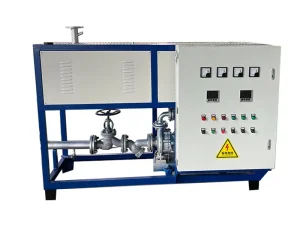
High-Quality Heat-conducting oil furnace Manufacturer, Exporter
Product Specs
High-Quality Portable Ceramic Heaters for Industry - Reliable Solutions
Product Specs
Engineering Knowledge Base
Frequently Asked Technical Questions (FAQ)
Clear, authoritative technical answers addressing design integration, thermal expansion differentials, CE electrical safety compliance, and bespoke manufacturing lead times.
What specific test standards govern CE Certification for Printed Thick Film Heaters?
Under the European Low Voltage Directive (LVD 2014/35/EU) and EN 60335-1 (Safety of Household and Similar Electrical Appliances), printed thick film heating elements undergo strict insulation testing. This includes cold dielectric withstand testing at 1500V to 3750V AC for 60 seconds without flashover or insulation breakdown, leakage current testing below 0.25 mA at peak operating temperature, and thermal stress tests ensuring the glass-ceramic overglaze does not craze, delaminate, or expose conductive ruthenium traces under rapid thermal cycling.
How does Kangpu prevent thermal expansion mismatch between substrate and dielectric layers?
Coefficient of Thermal Expansion (CTE) mismatch is the primary mechanical failure mechanism in thick film components. We utilize specialized ferritic stainless steel (such as SUS430, CTE ~10.5 × 10⁻⁶/K) paired with proprietary glass-ceramic dielectric pastes specifically engineered to match the substrate's expansion curve within ±0.3 × 10⁻⁶/K. This tight alignment guarantees that throughout tens of thousands of rapid thermal transitions from ambient to 350°C, the dielectric interface remains free from micro-cracking and interfacial shear separation.
Can thick film heaters incorporate integrated temperature sensors on the same plane?
Yes. One of the strongest advantages of Kangpu’s additive printing technology is the ability to co-deposit platinum-based PT100/PT1000 or proprietary NTC/PTC resistance thermometer patterns directly onto the dielectric layer, mere millimeters from the active heating track. This co-planar integration eliminates the thermal delay inherent to external spring-loaded thermocouples, enabling instantaneous over-temperature cut-off protection and precise PID loop control.
What are the lead times and NRE costs for custom OEM geometries?
Our 7-stage engineering service begins with ID design and screen tooling layout. Rapid prototyping for real-mold samples generally completes within 10 to 18 business days, including CAD stencil fabrication and initial test firings. Full mass production lead times typically range from 3 to 4 weeks depending on batch volume, with batch traceability logs and full CE compliance certificates provided with every export shipment.
How does thick film power density compare to traditional mineral-insulated elements?
Conventional mineral-insulated (MgO) tubular heaters typically top out at 15 to 25 W/cm² to prevent internal resistance wire burnout, while mica band heaters rarely exceed 4.5 W/cm². In contrast, Kangpu’s printed thick film elements operate comfortably between 30 and 60 W/cm² in fluid contact environments, and can achieve up to 100 W/cm² in specialized forced-flow applications, reducing system footprint by up to 75%.