
Specialized Thermal Elements & Heating Systems
High-precision surface heating arrays, industrial thermocouples, and heating-cooling integrated components built to stringent quality standards.

China Portable Ceramic Heaters for Industry Manufacturers, Exporter
View Specifications
High-Quality Thermocouple Exporter, Factory
View Specifications
Best Heating/Cooling Integrated System Exporter, Exporters
View Specifications
CE Certification Efficient Air Duct Heaters for HVAC Manufacturer, Factory
View Specifications
CE Certification Fan Manufacturer, Factory
View Specifications
High-Quality Portable Ceramic Heaters for Industry - Efficient Heating Solutions from China Suppliers and Factory Exporter, Exporters
View Specifications
CE Certification Explosion Proof Electric Heater Exporter, Factory
View Specifications
High-Quality Portable Ceramic Heaters for Industry - Reliable Heating Solutions from China Suppliers and Factory Manufacturers, Factory
View SpecificationsEngineering Architecture of Silicone Rubber Heaters
An authoritative engineering breakdown of dielectric encapsulation, resistance foil etching, thermal mechanical endurance, and operational profiles.
Silicone rubber heaters represent a transformative milestone in the domain of flexible surface heating elements. Built from fiberglass-reinforced silicone rubber composite sheets that encapsulate an engineered resistance heating circuit, these systems balance mechanical conformability, low thermal mass, high dielectric strength, and chemical inertia. As global automation demands higher operational efficiency and precise temperature uniformity across non-planar substrates, Chinese manufacturing infrastructure has led the transition from conventional hand-wound resistive wires to ultra-thin, computer-optimized chemical etched foil geometries.
Dielectric Substrate Engineering
Formulated from cross-linked polydimethylsiloxane (PDMS) compounded with woven structural fiberglass fabrics. This construction provides sustained thermal stability up to continuous temperatures of 200°C (with peak limits of 250°C), while maintaining dielectric withstand ratings over 2,000 V AC.
Etched Foil Circuit Topology
Utilizing high-nickel alloy foils (typically Nichrome 80/20 or Inconel 600) etched down to thicknesses between 0.025 mm and 0.1 mm via CAD-driven photolithography. This design enables multidirectional thermal profiles, localized watt-density zoning, and eliminates cold edge margins.
Integrated Thermal Sensing
Laminating thermal sensors directly within the vulcanized assembly—such as Pt100/Pt1000 RTDs, Type J/K thermocouples, or bi-metal snap thermostats—minimizes thermal resistance between element and sensor, preventing runaway conditions and improving PID loop stability.
The structural advantage of flexible heaters relies on thermodynamic contact conduction. While conventional ceramic and cast-in heaters depend on conduction across rigid gaps or secondary radiative transfer, vulcanized silicone pads adhere directly to curved or irregular tooling using pressure-sensitive acrylic adhesives (PSA), room-temperature vulcanizing (RTV) silicone, or integrated springs and eyelets. The result is an immediate transfer coefficient exceeding 92% efficiency directly to the heated substrate.
Critical Application Deployments Worldwide
Tailored thermal solutions engineered to meet exacting mechanical, electrical, and environmental demands across global market sectors.
Lithium-Ion Battery Thermal Management
Deployed in extreme cold-climate EV transit fleets and stationary containerized battery energy storage systems (BESS). Thin-profile silicone heaters prevent electrolyte crystallization and retain lithium plating resistance down to -40°C, maintaining safe pre-charge conditions.
Semiconductor Processing Equipment
Utilized in dry-etch forelines, gas delivery systems, and vacuum exhaust manifolds. Multi-zone silicone heaters prevent wafer manufacturing gas byproducts (like ammonium fluorosilicate) from sublimating into solids, maintaining laminar pump exhaust flow.
Medical Diagnostics & Analytical Devices
Incorporated into surgical blood warmers, clinical centrifugal analyzers, and incubators. The thin profile and low outgassing vulcanized compounds supply rapid, tight temperature control (within ±0.2°C) without electromagnetic interference.
Aerospace Radar & Optical De-Icing
Conformal etched patterns bonded behind commercial aircraft radomes, avionics bays, and maritime satellite reflectors guarantee clear signal paths by matching heat output to aerodynamic heat loss profiles.
China Factory Supply Chain Resilience & Production Scale
Vertically integrated material pipelines, fully automated laser-etching arrays, and rapid prototyping workflows driving cost predictability.
The manufacturing ecosystem for thermal management elements in China has matured from simple manual processing into a sophisticated, highly automated industrial network. Industrial regions—such as Jiangsu and Guangdong—house fully integrated supply clusters spanning refined siloxane chemical producers, precision metallurgical cold-rolling mills for resistance alloys, precision CNC laser-etching infrastructure, and accredited third-party test laboratories. This supply integration offers distinct technical and delivery advantages for multinational engineering teams:
Vertically Integrated Raw Materials
Direct supply contracts with domestic primary polysiloxane and high-grade quartz suppliers prevent material shortages and protect against raw material price volatility, supporting consistent long-term contract pricing.
Rapid Design-to-Sample Cycles
In-house photolithography and precision digital tooling allow complex, custom etched foil profiles to move from CAD approval to physical, vulcanized functional samples in just 72 to 96 hours, greatly shortening OEM qualification phases.
Automated Quality Assurance
Every continuous roll runs through automated optical inspection (AOI) to detect trace micro-fractures, followed by 100% inline dielectric testing, resistance testing, and insulation leakage validation up to 100 MΩ at 500 V DC.
Silicone Rubber Heaters vs. Alternate Industrial Heaters
Performance metrics across core industrial heating technologies to assist engineering and procurement decisions.
| Heating Technology | Max Operating Temp | Flexibility & Fit | Thermal Response | Typical Industrial Target |
|---|---|---|---|---|
| Silicone Rubber Heaters | 200°C - 250°C | Extreme (Bend Radius down to 3 mm) | Very Fast (Low thermal mass) | Battery warmup, medical instruments, tank warming, electronics de-icing |
| Mica Band Heaters | 300°C - 350°C | Rigid Cylindrical Only | Moderate | Injection nozzles, small cylindrical extruder sections |
| Ceramic Band Heaters | 500°C - 700°C | Segmented Curve Only | Slower (High heat storage) | Heavy plastic extrusion, polymer melt pipelines |
| Cast-In Metal Heaters | 400°C - 650°C | Fixed Machined Solid Mass | High Thermal Inertia | High-wear plastic barrels requiring integrated liquid/air cooling lines |
Technology Roadmap: Next-Generation Flexible Heating
Advancing flexible thermal systems into new realms of efficiency, material purity, and integrated telemetry.
Graphene-Enhanced Conductive Elastomers
By blending pristine graphene nanoplatelets directly into the siloxane matrix, researchers are building heaters with isotropic heat dispersion across the entire surface. This approach removes localized wire hot-spots and increases overall thermal conductivity by up to 35%.
Ultra-Low Outgassing Formulations
High-vacuum space instruments and semiconductor cleanrooms demand zero volatile organic compound (VOC) release. Post-curing at 230°C in high-vacuum chambers removes cyclic siloxanes, achieving Total Mass Loss (TML) metrics well under <1.0%.
IoT-Enabled Predictive Health Monitoring
Integrating micro-printed conductive sensor grids provides real-time electrical resistance telemetry back to factory controllers. These systems detect internal mechanical fatigue or delamination before an open-circuit failure occurs.
Global Regulatory Compliance & Rigorous Quality Control
Meeting high manufacturing and electrical safety standards for demanding industrial applications worldwide.
Safety Certifications: UL 499 & CE
Components undergo dielectric withstand verification, leakage current audits, and flammability testing under UL 94 V-0 flame-retardant parameters to ensure broad compliance across North American and European industrial markets.
RoHS & REACH Environmental Directives
Every raw material batch undergoes chemical analysis to confirm complete absence of restricted heavy metals, phthalates, PFOA/PFOS compounds, and halogenated fire-retardants, matching modern ecological and recycling directives.
Traceable Batch Quality Protocol
Each production run retains serialized digital production logs tied to raw material lots. Tensile shear testing, surface peel testing, and burn-in heat testing are documented for 5-year traceable accountability.
Frequently Asked Questions: Silicone Rubber Heaters
Answers to common technical, design, and manufacturing questions for industrial procurement and engineering teams.
What is the maximum allowable watt density for silicone rubber heaters without causing premature degradation?
How do etched foil and wire-wound silicone rubber heating constructions compare?
What attachment methods are recommended for field installation vs. factory integration?
Can silicone heaters be engineered with integrated internal thermal cutoffs or sensors?
What environmental factors and chemicals can silicone rubber heaters resist?
Specialized Heavy Process Heating Systems
Industrial infrared modules, thermal oil furnaces, electromagnetic steam systems, and specialized industrial heaters.

Best Infrared Ceramic Heaters for Efficient Heating Manufacturers, Exporters
View Specifications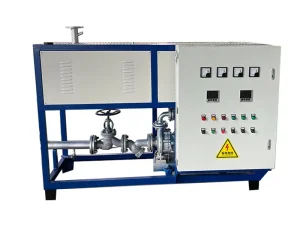
High-Quality Heat-conducting oil furnace Manufacturer, Exporter
View Specifications
High-Quality Electromagnetic steam boiler Manufacturers, Factories
View Specifications
China Portable Ceramic Heaters from China Suppliers: Efficient Heating Solutions for Factories and Industries Manufacturer, Exporters
View Specifications
China High density heating element Manufacturers, Factories
View Specifications
High-Quality Cleaning furnace Manufacturer, Exporter
View Specifications
CE Certification Precise Cooling and Heating System Manufacturers, Exporters
View Specifications
China Efficient Portable Ceramic Heaters for Industry | China Suppliers & Factory Exporters, Factories
View Specifications