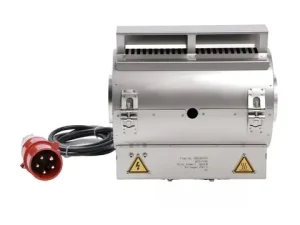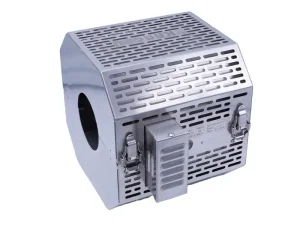




Modern plastics processing, blown-film manufacturing, and sheet extrusion operations are challenged by energy consumption volatility and stringent dimensional stability targets. Industrial operations requiring temperature profiles in the range of 300°C to 700°C cannot rely on conventional heat conduction mechanisms that exhibit high radiant loss and dielectric breakdown under duty-cycle loading.
A high-performance ceramic insulated band heater integrates high-purity steatite or alumina ceramic knuckles that interlock to house high-grade Nickel-Chromium (NiCr 80/20) resistance wire. Unlike standard mica bands that rely purely on direct conductive contact, ceramic band heaters transfer thermal energy through both direct conduction and uniform infrared radiation. Built-in ceramic fiber insulation layers attenuate outward dissipation, dropping outer sheath temperatures, reducing air-conditioning loads in cleanroom environments, and achieving energy savings up to 25%–30%.
Grid Decarbonization Mandates
Global manufacturing facilities face tightening ESG regulations and surging electrical utility tariffs. Replacing bare steel-clad heaters with ceramic-insulated configurations reduces direct kilowatt-hour operational consumption across multi-zone barrel assemblies.
High-Performance Resins
Processing advanced engineering polymers like PEEK, PTFE, and fluoropolymers demands operational stability above 400°C. Mica dielectric bands decompose under these thermal profiles; interlocking ceramic matrices provide the necessary insulation without degradation.
Continuous OEM Standardization
Primary extrusion line builders standardize modular band heating geometries. Factory-direct engineering ensures replacement bands preserve bolt configurations, thermocouple ports, and cooling shrouds without custom barrel modifications.
Twin-Screw Extruders
Critical barrel zones require high watt densities to maintain steady-state melt conditions without localized hot-spots that degrade polymer chains.
Injection Barrel Systems
Fast thermal cycling, mechanical vibration tolerance, and resistance to plastic drool contamination during high-speed cycle times.
Blown Film Die Heads
Uniform circumferential heat distribution avoids gauge variation in high-tolerance barrier packaging film production lines.
Chemical Autoclaves
Cylindrical pressure vessel heating requiring certified explosion-proof junction boxes and corrosion-resistant sheath metals.
As an established factory partner for Tier-1 machinery manufacturers across North America, Europe, and the Asia-Pacific region, we adhere to strict quality control and verification standards. Every batch of ceramic insulated band heaters passes high-potential dielectric testing, insulation resistance validation under ambient and operating temperatures, and dimensional tolerance confirmation.
CE Low Voltage Directive
Built and certified to meet EN 60335-1 and EN 60519-1 electrical safety directives, guaranteeing structural breakdown resistance.
RoHS & REACH Compliance
Zero hazardous substances in ceramic binders, refractory insulation blankets, lead wire sleeving, or terminal blocks.
Traceable QC Validation
Every unit undergoes hipot testing at 1500V/min, cold resistance indexing, and laser-etched batch identification.
Protective Clamping Systems
Engineered with spring-loaded or barrel-nut clamping assemblies to accommodate thermal expansion without surface detachment.
Phase 1: Embedded RTD Sensing
Direct integration of Class-A Pt100/Pt1000 thin-film detectors and J/K thermocouples inside the ceramic matrix, bringing sensing points closer to the melt boundary.
Phase 2: High-Purity Alumina Blends
Next-generation ceramic compositions engineered with 96%+ alumina cores, achieving higher dielectric strength and thermal conductivity while reducing wall thickness.
Phase 3: Aerogel Hybrid Shells
Integrating nanoporous silica aerogel outer shells to replace conventional bulk fiber insulation, reducing radial heater profiles and casing temperatures below 60°C.
What is the maximum operating temperature of a ceramic insulated band heater?
Standard ceramic band heaters operate continuously at temperatures up to 650°C (1200°F), with custom builds using high-grade stainless steel or Incoloy sheaths accommodating excursions up to 700°C.
How does a ceramic band heater differ from a mica band heater in performance?
Mica heaters rely purely on direct contact conduction and are limited to ~350°C with lower watt densities (up to 25-30 W/in²). Ceramic band heaters operate up to 700°C, leverage radiant heat transfer, and include an insulation blanket that reduces energy consumption and cuts external casing temperatures.
Can you provide custom cutouts, thermocouple holes, and terminal box options?
Yes. Custom engineering includes CAD-guided cutouts, pre-punched thermocouple guide holes, dual-voltage configurations, Euro-plugs, terminal blocks, fiberglass lead wires, and explosion-resistant terminal boxes.
What clamping styles are recommended for large-diameter barrels?
For diameters over 12 inches (300mm), built-in spring-loaded strap clamping or heavy-duty barrel-nut flanges are recommended. These accommodate thermal expansion during cycling and maintain continuous surface contact.
What lead time is standard for OEM and custom export orders?
Standard custom prototypes and pre-production evaluation units ship in 5 to 7 working days. Full container production orders generally clear factory dispatch and quality testing in 2 to 3 weeks.