
Primary High-Density Thermal Systems & Elements
Precision thermal solutions engineered by Kangpu Heater (Yancheng Laier Heating Technology Co., Ltd.) to overcome localized thermal inertia, optimize melt homogeneity, and deliver continuous watt density reliability.







Commercial & Industrial Landscape of Hi-Density Cartridge Heating
Evaluating thermodynamic efficiency, compaction dynamics, and high-watt-density reliability across advanced modern manufacturing environments.
In the rapidly advancing landscape of high-precision thermal processing, the demand for high-density cartridge heaters (also known in metallurgical nomenclature as swaged high-watt-density insertion heaters) has transitioned from standard auxiliary resistance components into mission-critical thermal management assets. Across global processing sectors—ranging from micro-injection molding manifolds and semiconductor packaging platens to aerospace carbon composite thermo-compression tooling—thermal precision dictates part consistency, cycle times, and operational yield rates.
Unlike low-density, uncompressed cartridge heaters which rely on standard ceramic cores inserted loosely into metallic tubes, hi-density cartridge heaters undergo a mechanical swaging (rotary swaging or reduction roll pressing) operation. This metallurgical reduction compresses granular magnesium oxide (MgO) insulation to upwards of 95% of its theoretical maximum density (typically 3.2 to 3.4 g/cm³). By closing microscopic interstitial air voids, the thermal conductivity barrier between the wound nickel-chromium resistance coil (NiCr 80/20) and the outer metallic sheath (Incoloy 800, Incoloy 840, or AISI 316L/304) is substantially eliminated.
Total Cost of Ownership (TCO)
Global procurement teams recognize that an underspecified cartridge failure brings unexpected downtime costing thousands of dollars per hour. Hi-density swaged cartridge construction delivers high MTBF (Mean Time Between Failures), ensuring multi-year uninterrupted operating lifespans.
Dynamic Thermal Response
Because the distance between the resistance coil and the outer sheath is reduced to millimeter fractions under high compaction, thermal lag is curtailed by up to 72% relative to conventional tubular elements, enabling ultra-tight PID controller tracking (±0.5°C).
Hermetic & Mechanical Integrity
TIG-welded end discs, swaged ceramic terminal blocks, and PTFE/silicone moisture barriers prevent hygroscopic contamination of magnesium oxide, eradicating cold-start leakage current and dielectric trip events in high-humidity industrial facilities.
Comprehensive Engineering Matrix: Low vs. High-Density
Comparative analytical breakdown of thermodynamic, mechanical, and dimensional constraints between standard cartridge units and Kangpu swaged high-density elements.
| Engineering Parameter | Standard Low-Density Element | Swaged Hi-Density Cartridge Element (Kangpu Standard) | High-Temperature Super-Alloy Edition |
|---|---|---|---|
| Maximum Surface Watt Density | 5 – 8 W/cm² (32 – 50 W/in²) | 25 – 40 W/cm² (160 – 260 W/in²) | Up to 50 W/cm² (325 W/in²) |
| Maximum Sheath Operating Temp | 400°C – 500°C (752°F – 932°F) | 750°C – 800°C (1382°F – 1472°F) | 870°C – 920°C (1600°F – 1688°F) |
| Insulation Compaction Density | 2.2 – 2.5 g/cm³ (Unswaged vibration) | 3.2 – 3.4 g/cm³ (Rotary swaged reduction) | >3.4 g/cm³ (Multi-pass cold swaged) |
| Outer Sheath Material Options | AISI 201 / AISI 304 Stainless Steel | AISI 316L / Incoloy 800 / Incoloy 840 | Inconel 600 / Incoloy 800 with Passivation |
| Outer Diameter Precision Tolerance | ±0.12 mm to ±0.20 mm | ±0.02 mm to ±0.04 mm (Centerless Ground) | ±0.015 mm (Micron-level Grinding) |
| Dielectric Strength (Cold Flash Test) | 1000V AC @ 0.5 mA / 1s | 1500V – 2000V AC @ 0.5 mA / 1s | 2500V AC @ 0.5 mA / 1s |
| Insulation Resistance (Cold State) | ≥ 20 MΩ @ 500V DC | ≥ 500 MΩ @ 1000V DC | ≥ 1000 MΩ @ 1000V DC |
| Integrated Temperature Sensor | External surface mount only | Internal Type J / K grounded or ungrounded | Internal Type N / Dual Duplex Sensors |
The precision centerless grinding documented above is vital. When a cartridge heater is installed into a reamed metal bore, thermal conductance drops precipitously as the diametrical clearance increases. A fit clearance exceeding 0.08 mm (0.003 inches) creates an insulating air gap that restricts heat escape, driving the internal core wire temperature hundreds of degrees beyond the sheath temperature, causing early burnout. Kangpu Centerless Grinding ensures precise H7/g6 bore tolerance matching, enabling instantaneous conductive energy dissipation.
The Chinese Manufacturing Advantage & Factory Efficiency
How four decades of concentrated heating element manufacturing in Jiangsu Province delivers unprecedented speed, custom engineering agility, and cost optimization.
Yancheng Laier Heating Technology Co., Ltd. (operating the globally recognized Kangpu Heater brand since 1986) sits at the nucleus of the world’s most sophisticated industrial heating supply ecosystem in Jiangsu, China. The manufacturing velocity and technical precision achieved within our facilities derive from complete vertical integration, which decouples production timelines from external vendor shortages.
Upstream Sourcing Synergy
Immediate access to high-purity crystalline fused MgO powder from Liaoning deposits and specialized nickel-chromium (Ni80Cr20) metallurgical wire ensures zero lot-to-lot chemical composition variance.
Automated CNC Swaging
Multi-station rotary swaging equipment compresses sheaths under continuous digital laser micrometer feedback, ensuring concentricity and eliminating resistance coil off-centering during radial compression.
Rapid Prototyping (NPI)
While Western suppliers quote 6 to 10 weeks for bespoke cartridge geometries, Kangpu delivers CAD-verified production samples within 5 to 7 operational days, accelerating equipment commissioning schedules.
Rigorous 100% End-of-Line QA
Every single cartridge undergoes automated helium leak rate checks, hot-state dielectric insulation breakdown testing, and Kelvin micro-ohmmeter coil resistance validation before shipping containers depart.
Localized Industrial Deployment Case Scenarios
Analyzing targeted real-world applications where thermal gradients, corrosive attack, and vibration demand swaged cartridge technology.
Hot Runner Tooling & Manifolds
In hot-runner injection molding for optical and automotive components, thermal delta variations across manifold drops cause viscosity imbalances. Kangpu profiled-wattage hi-density cartridges compensate for edge-block radiation losses, maintaining identical melt viscosity (±1°C) across all 32 or 64 drops.
Semiconductor Die Bonding Platens
Wafer packaging and thermosonic flip-chip bonding demand ultra-fast temperature stepping (ambient to 380°C within seconds) without overshoot. Micro-diameter (1/8" and 3.0mm) swaged cartridges provide high energy density while resisting thermal shock degradation under high-frequency cycling.
Medical Fluidics & Surgical Sealers
Continuous seal-jaw heating for sterile surgical pouch packaging requires pure, non-oxidizing operation. Electropolished Incoloy sheaths with high-temperature internal thermocouples guarantee zero particulate shedding, ensuring compliance with ISO Class 7 cleanroom protocols.
High-Pressure Die Casting (HPDC)
Aluminum and magnesium casting shot sleeves and sprues require intensive localized heat to prevent pre-solidification skin defects. Our heavy-wall Inconel cartridge units withstand molten metal splashes, structural machine vibration, and cyclical mechanical impact without element fracture.
High-Speed Form-Fill-Seal (FFS) Packaging
Modern packaging machines running at 300 cycles per minute generate relentless mechanical vibration on heating bars. Fitted with flexible braided stainless steel leads, silicone-impregnated fiber sleeving, and swaged-in internal connections, Kangpu elements stop lead-fatigue failures.
Aerospace Composite Tooling
Carbon-fiber autoclave and out-of-autoclave resin transfer molding (RTM) require zone-controlled platen platens spanning multiple meters. Zoned wattage distribution elements eliminate peripheral heat sinks, delivering strict AMS 2750 pyrometry compliance across all tooling faces.
Technological Trends Transforming Industrial Cartridge Heating
Discover how micro-sensors, surface nanocoatings, and distributed wattage algorithms are setting new benchmarks for efficiency.
Embedded Smart Sensors
Integration of ultra-thin dual thermocouples (Type K or J) positioned directly at the bottom disc, midpoint, or sheath surface enables real-time thermal gradient telemetry, alerting PLC architectures to hot spots before burnout occurs.
Anti-Seize Nano Sheath Coatings
High-temperature galling often locks spent heaters permanently into precision tool bores, requiring EDM spark erosion to remove. New nano-ceramic and nickel-graphite factory coatings prevent metal diffusion at 700°C, enabling rapid slip-out extraction.
Algorithm-Driven Profiled Wattage
By varying the helical pitch of the Ni80Cr20 wire along the ceramic core, watt density is concentrated at heater ends (up to 35% higher power at tips) to counterbalance convective bore perimeter dissipation, achieving perfectly uniform axial heat across long platen spans.
Technical Specifications & Procurement Checklist for Global Buyers
Key engineering inputs necessary to eliminate field failures and guarantee plug-and-play mechanical installation.
When sourcing high-density cartridge heaters for critical OEM equipment or factory maintenance retrofits, vague specifications like "1/2 inch by 10 inch, 1000W" inevitably lead to mismatched expectations, poor fitment, and premature element breakdown. Global procurement teams should follow this structured technical checklist when issuing requests for quotation (RFQs):
1. Dimensional Geometry & Fit
State exact nominal diameter vs. actual centerless ground diameter (e.g., nominal 12.7 mm, actual ground to 12.62 mm ±0.02 mm for H7 bore insertion). Specify total sheath length, unheated cold zones (standard 6mm to 12mm at bottom, 15mm to 25mm at lead exit), and right-angle or flange mount configurations.
2. Electrical Ratings & Tolerances
Indicate operating voltage (110V, 220V, 240V, 380V, 480V) and total wattage. Power tolerance must adhere to strict international standards (typically +5% / -10% per DIN 44874). Verify cold resistance parameters and maximum permissible operational leakage current (<0.5 mA at working temperature).
3. Termination & Lead Protection
Define lead wire construction: swaged-in flexible leads (for high flexing/vibration) vs. externally crimped leads. Specify insulation type: high-temperature fiberglass braid (450°C), Teflon/PTFE (moisture resistant, 250°C), silicone rubber, or stainless steel overbraid/armor conduit for mechanical abrasion resistance.
Kangpu 7-Stage Controlled Customization Methodology
From client blueprint submission through serial delivery, our controlled NPI procedure ensures zero defect reproduction.
Design & Clearance Review
Senior thermal engineers analyze bore depth, calculated watt density, operating ambient temperature, and mechanical lead exit angles.
Specification Freezing
Confirm exact core resistance winding pitch, high-density MgO grade, lead sleeve options, and internal thermocouple type (J/K/PT100).
Precision Tooling & Mold
Tooling setup for rotary reduction dies and centerless grinding fixtures tailored precisely to the custom diameter specified.
Pilot Sample Delivery
Production-line quality prototype dispatched to customer facilities for physical bore fitment, thermal curve verification, and PID calibration.
Engineering Iteration
Incorporation of site-specific feedback—such as adjusted cold lengths, altered lead exit orientation, or customized anti-seize coating.
Thermal Stress Verification
High-voltage dielectric breakdown, insulation resistance under saturated humidity, and cycling tests up to 800°C.
Batch Scaled Manufacturing
Automated serial production backed by laser-etched lot traceability and our unconditional 5-year after-sales factory warranty.
Frequently Asked Engineering & Procurement Questions
In-depth answers addressing thermal calculations, failure modes, material selections, and export logistics.
How do you calculate the maximum allowable watt density for a cartridge heater in a metal platen?
Why do standard cartridge heaters fail rapidly in high-speed packaging machinery?
What is the mechanical difference between swaged-in leads and externally crimped leads?
Which sheath material should I choose: AISI 304, AISI 316L, or Incoloy 800/840?
How does Kangpu Heater implement batch traceability and its 5-year warranty?
Extended Industrial Heating Systems, Furnaces & Accessories
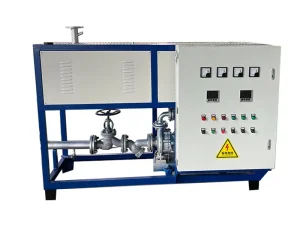
Explore our complementary engineered heating lineup, including thermal fluid furnaces, explosion-proof units, PVC-O orientation ovens, and precision thermal sensors.






Accelerate Your Thermal System Efficiency
Connect directly with our senior application engineers in Yancheng, Jiangsu. Send your CAD drawings, bore tolerances, or application duty cycles for rapid thermal simulation, quotation, and custom sample fabrication.