

Primary Thermal Generation Equipment
Engineered heating components, precision assemblies, and process-critical elements configured for closed and open-loop thermal water circuits.





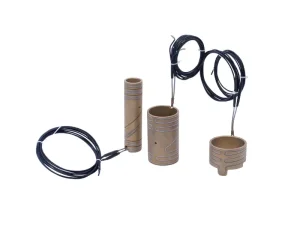

Technical Architecture: Modern Water System Heating
Decoupling reliance on fossil fuels requires deep thermodynamic optimization, precise watt-density distribution, and metallurgy specialized for extreme hydronic cycles.
Hydronic Boundary Layer Management
Electric heating within pressurized liquid loops faces intense surface cavitation and localized boiling risks. Our industrial water elements incorporate continuous surface flux management down to 6.2 W/cm², significantly preventing calcium crystallization, surface scale deposition, and premature sheath breakdown.
Corrosion-Resistant Metallurgy
Water chemistry varies drastically from demineralized pure loops to aggressive municipal brine. We utilize Incoloy 800/840, high-grade AISI 316Ti, and electropolished Hastelloy sheaths paired with electro-compacted 99.4% purity Magnesium Oxide (MgO) dielectric insulation to stop pinhole pitting corrosion cold.
Rapid Dynamic Response Control
Modern process water systems require millisecond response to variable flow rates. Through close integration with triac and SCR zero-cross power firing units, our systems eliminate thermal inertia, preventing process temperature overshooting even during rapid volumetric batch discharges.
Macro Industry Application Solutions
Tailored electro-thermal configurations engineered specifically for mission-critical hydraulic platforms and heavy industrial infrastructure.
District & Commercial HVAC Central Systems
For municipal centralized hot water loops, our high-tonnage circulation inline vessels offer emission-free hot water buffering. By eliminating chimney stack heat losses common in natural gas boilers, plant operators achieve over 99.2% electrical energy-to-fluid thermal transmission rates.
Pharma & Chemical CIP/SIP Pure Water Circuits
Demanding absolute zero contamination, our water loop sanitization systems feature crevice-free robotic TIG welds, sanitary tri-clamp fittings, and passivation certified to ASTM A967 standards, ensuring clean-in-place water reaches exact sterilizing thresholds without batch cross-contamination.
Industrial Mould Temperature Control Units (TCU)
In high-precision injection molding and composite curing, pressurized hot-water TCUs can operate reliably up to 180°C. Our specialized immersion heater core geometries handle extreme cyclical hydraulic surges without fracturing core resistance spirals.
China Factory 4.0: Supply Chain Resilience & Lean Efficiency
Harnessing four decades of direct manufacturing know-how based in Yancheng, Jiangsu: precision manufacturing meets vertical supply agility.
End-to-End Vertical Manufacturing Integration
Unlike regional trade middlemen, Kangpu Heater (Yancheng Laier Heating Technology) controls the entire lifecycle: from in-house wire winding, automatic MgO high-density compaction, annealing, real-mold casting, to CNC flange turning. This structural integration eliminates production bottlenecks, reduces component lead times by up to 45%, and guarantees full physical batch traceability.
Real-Mold Pre-Production Verification
We implement a strict 7-stage custom engineering workflow. Instead of shipping unvalidated hand-assembled prototypes, our factory crafts dedicated real production molds for every bespoke iteration. This assures tier-one machinery builders and engineering contractors that physical fit, cold resistance, and insulation resistance reflect actual mass assembly standards.
Global Enterprise Procurement: Comparative Performance Matrix
Comprehensive engineering evaluation for plant managers, EPC procurement leads, and equipment specifiers.
| Heating Technology Architecture | Typical Fluid Application | Max Operational Pressure | Thermal Efficiency Rating | Life Expectancy & Failure Modes |
|---|---|---|---|---|
| Flanged Immersion Heaters | Closed-loop water circuits, storage tanks | Up to 40 Bar | 99.0% - 99.5% | 8 - 12 Years (Minimized via low surface watt density) |
| Direct Inline Circulation Vessels | Process circulating cooling/heating loops | Up to 64 Bar | 98.5% - 99.2% | 10+ Years (Internal baffle plates prevent hot spots) |
| Cast-In High Uniformity Blocks | Mould hydraulic heating, water jackets | Standard Dynamic Cycles | 94.0% - 96.5% | 12 - 15 Years (Sheathed elements shielded from physical impact) |
| Electromagnetic Induction Boilers | Superheated water generation, steam systems | Up to 100 Bar | 97.5% - 98.8% | 15+ Years (Non-contact heating prevents element scale burnout) |
Technology Roadmap & Future Outlook (2025–2030)
How next-generation thermal fluid engineering is addressing the dual imperatives of zero-emission decarbonization and industrial IoT connectivity.
IoT-Enabled Predictive Sheath Sensing
Embedding micro-thermocouple arrays directly adjacent to internal resistance coils allows real-time measurement of sheath-to-fluid thermal conductivity. Our emerging smart element array transmits predictive fouling signals via Modbus/OPC-UA before surface scale causes fatal dry burnout.
Silicon Carbide (SiC) Composite Dielectrics
Research underway in our Yancheng laboratories explores specialized ceramic nanocomposites to supplant standard mineral insulation in ultra-high temperature water systems, targeting a 30% jump in thermal conduction while preserving electrical isolation up to 3,000V AC.
Zero-Carbon Hydraulic Transitioning
As multinational manufacturing operations phase out coal and fossil gas boilers to comply with stringent Scope 1 and Scope 2 carbon mandates, large-scale multi-megawatt electric hydronic systems serve as the core technical pillar for industrial plant decarbonization.
Localized Global Support & Regulatory Compliance
Direct technical backing that bridges continents with validated international engineering and safety standards.
Pressure Equipment Directives (PED & ASME)
Exporting electric heaters for pressurized water vessels requires meticulous compliance. Our flanged systems and circulation chambers are engineered to harmonize seamlessly with PED 2014/68/EU guidelines, ASME Section VIII standards, and CE Low Voltage Directives.
Ex-Proof Environments (ATEX & IECEx)
For installations in volatile processing environments, terminal connection enclosures are manufactured with rugged IP66/IP67 ratings, incorporating explosion-proof junction enclosures that isolate arcing hazards from combustible dust or vapor atmospheres.
Direct Multi-Lingual Engineering Support
Our sales and technical response teams bypass commercial agents, giving procurement managers direct access to electrical design engineers fluent in both drawing interpretation (CAD/SolidWorks) and cross-border project logistics across more than 100 countries.
Frequently Asked Questions (FAQ)
In-depth technical answers addressing engineering parameters, customized builds, quality validation, and supply continuity.
How do you determine the correct watt density for an industrial water heating system?
Watt density (W/cm²) is the most critical variable determining element life and fouling rate. For stagnant or slow-moving domestic water, watt densities typically range between 6.0 and 8.0 W/cm² to prevent mineral calcification. In high-velocity, forced-circulation industrial loops with demineralized or treated water, watt densities can safely reach 10.0 to 12.0 W/cm². Our engineers compute surface flux precisely based on water chemistry, flow velocity, operating temperature, and sheath metallurgy.
Can Kangpu manufacture replacement immersion heaters directly from existing mechanical drawings or damaged samples?
Yes. Customization is our foundational core competency. You can supply physical CAD schematics, dimensional blueprints, or ship a decommissioned sample directly to our facility. Our engineering lab deconstructs the geometry, pinpoints the flange connection, verifies dielectric compaction density, and calculates electrical parameters to build a fully validated replacement unit that drops right into your system footprint.
What electrical testing standards are applied prior to batch dispatch?
Every single heating element undergoes non-destructive electrical and structural verification before packing: 100% cold resistance verification, high-potential (Hi-Pot) insulation withstand testing (typically 1,500V to 2,500V AC), insulation resistance checking (>100MΩ at 500V DC under ambient conditions), and helium leak or hydrostatic pressure testing for flanged assemblies to ensure absolute seal integrity under operational pressures.
How does the 5-year after-sales warranty work in practical export scenarios?
Our five-year coverage is anchored by strict batch traceability. Every unit is laser-engraved with an internal batch production identifier. In the unlikely event of an element failure under documented operational parameters, our quality control team pulls the exact manufacturing logs, raw material mill sheets, and QC checkpoints to determine the root mechanical or electrical cause, ensuring prompt component replacement without bureaucratic delays.
What differentiates ceramic band and cast-in heaters when applied to water jacket circulation?
Ceramic band heaters rely on radiant and conductive transfer through engineered ceramic knuckles, making them lightweight and easy to install on exterior barrel surfaces. Cast aluminum or cast copper heaters, conversely, embed tubular elements directly within dense solid metal castings, delivering unparalleled heat transfer uniformity, rugged resistance against moisture splashes, and the option to integrate integrated cooling fluid coils inside the single casting.
Advanced Process Heaters & Control Systems
Continuous pipeline heating vessels, electromagnetic solutions, and dynamic process monitoring components built to withstand heavy industrial duty cycles.




