
Engineered Heating Elements & Process Heating Solutions
Browse our proven industrial thermal components designed for maximum heat dissipation, chemical resistance, and high-efficiency fluid and surface dynamics.

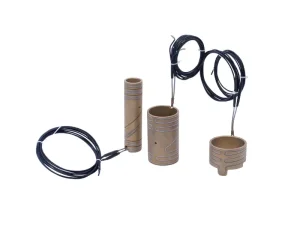



Engineering Architecture of Low Profile Immersion Heaters
Analyzing thermal fluid dynamics, watt density management, and metallurgical specifications in space-constrained industrial heating environments.
Boundary Layer Fluid Dynamics
Low profile immersion heaters operate under severe vertical clearance limitations, typically less than 50mm to 100mm from tank bottoms or lateral sumps. Fluid dynamics in such low geometries demand specialized element layouts that maintain natural or forced convective circulation, preventing localized boiling and thermal stagnation.
Optimized Surface Watt Density
Preventing fluid coking and sheath degradation requires precision control of watt densities (ranging from 1.5 to 8.5 W/cm² depending on the medium). Using multi-tier flat tubular bending or cast-in alloy plates allows large heat transfer areas in compact profiles, maintaining safe operating temperatures for both aqueous solutions and synthetic oils.
Advanced Metallurgical Sheathing
Immersion sheathing options such as Incoloy 800/840, SS316L, Titanium Grade 2, and electro-polished fluoropolymer (PTFE/PFA) sleeves guarantee resistance against corrosive acids, alkaline degreasers, and aggressive deionized water. High-grade metallurgical bonds resist thermal cycling shock without micro-fissuring.
Mission-Critical Deployment Scenarios
How leading manufacturers and systems integrators configure low profile immersion elements across diverse international factory environments.
Semiconductor Wet Benches
Ultra-pure chemical processing and etching rinse tanks require extremely shallow, low profile immersion elements built with virgin PFA coatings to prevent metallic ion contamination and ensure class-100 cleanroom compliance.
Industrial Degreasing & Plating
Electroplating, anodizing, and ultrasonic cleaning baths rely on horizontally configured low profile heaters resting beneath parts baskets. This maximizes usable liquid depth while resisting aggressive chemical baths.
Food & Beverage Cooking Wells
Sanitary food production lines utilize 3-A and FDA compliant low profile immersion systems inside steam kettles, fryer sumps, and pasteurization vats, ensuring uniform heat without scorched residue.
Plastic Extrusion Quench Tanks
Seamless integration along water cooling baths and calibration troughs for PVC, PE, and PVC-O pipe manufacturing lines, delivering fast thermal recovery and exact liquid temperature consistency.
Global Commercial & Industrial Landscape
Industrial electrification and compact equipment engineering are driving unprecedented demand for optimized thermal management hardware.
Electrification & Decarbonization
Global corporate mandates to phase out fossil fuel-powered direct combustion boilers have shifted industrial attention toward high-output electric immersion modules. Factory operators in North America and the EU are replacing gas lines with precision multi-zone electric immersion modules capable of handling thermal demands with near 99% energy efficiency.
Skid Footprint Minimization
Modern factory floors prioritize modular process skids with compact footprints. Conventional bulky immersion heaters requiring extensive horizontal withdrawal clearance are being retired in favor of custom low profile geometry, which slashes required clearance corridors by more than 45%.
Total Cost of Ownership (TCO)
Procurement directors are assessing low profile immersion systems based on mean time between failures (MTBF), resistance to scale buildup, and sheath watt densities. Premium low profile manufacturing lowers operational down-time and eliminates frequent plant shutdowns.
China Factory Supply Chain Resilience & Efficiency Advantages
How Yancheng Laier Heating Technology leverages vertical integration, localized raw material ecosystems, and advanced robotics to deliver cost leadership.
Cluster Synergies in Jiangsu
Situated in the premier industrial manufacturing belt of Yancheng, Jiangsu, our facility benefits from immediate access to ultra-pure magnesium oxide (MgO), precision seamless alloy tubing, nickel-chromium resistance coils, and CNC machining centers, reducing material transit lead times to near zero.
Vertical Production Integration
From drawing and element annealing to multi-axis CNC bending, automated TIG/laser welding of mounting flanges, automated filling of dielectric insulation, and helium mass spectrometer leak detection, all operations remain strictly 100% in-house under single-roof quality protocols.
Rapid Tooling & Mold Production
Our proprietary 7-stage service process transitions from customer CAD files to real-mold physical functional samples in as few as 5 to 7 working days, ensuring zero project lag for international machinery builders commissioning prototype series.
Technology Roadmap & Future Outlook (2025–2030)
Pioneering next-generation materials, intelligent sensor integration, and high-efficiency thermal architectures.
Embedded Thin-Film Sensor Mesh
Integrating multi-point distributed fiber-optic Bragg grating (FBG) and microscopic RTD thin-film sensors directly inside the element sheath. This enables real-time sheath surface thermal mapping, eliminating hot spots and dry-fire risks before damage can manifest.
Graphene & Nano-Ceramic Coatings
Deploying chemical-vapor-deposited (CVD) nano-ceramic barrier coatings that resist mineral scale buildup in hard-water systems and increase overall radiative and convective heat transfer rates by up to 22% compared with bare alloy sheaths.
Edge IoT & Predictive Maintenance
Next-gen terminal enclosures equipped with native Modbus/CANopen communications and edge analytics modules. Heaters stream dielectric leakage data and resistance drift directly to plant SCADA networks, enabling predictive replacements during scheduled shifts.
| Heater Architecture | Profile Height (mm) | Typical Watt Density (W/cm²) | Maximum Sheath Temp | Ideal Application Fluid |
|---|---|---|---|---|
| Low Profile Tubular Flat-Loop | 25 mm – 45 mm | 3.0 – 6.5 W/cm² | 750°C (1382°F) | Water, Degreasers, Alkaline Rinse |
| Cast-in Alloy Immersion Plate | 15 mm – 30 mm | 2.0 – 4.5 W/cm² | 450°C (842°F) | Thermal Oils, Viscous Lubricants |
| PTFE/PFA Fluoropolymer Low Profile | 30 mm – 55 mm | 1.5 – 2.5 W/cm² | 130°C (266°F) | Semiconductor Acids, Harsh Chemistry |
| Nano Infrared Direct Radiative | 35 mm – 60 mm | 4.0 – 8.0 W/cm² | 600°C (1112°F) | Rapid Fluid Conditioning Wells |
Localized Support & International Compliance Assurance
Strict adherence to regional electrical, mechanical, and safety standards for seamless plant integration worldwide.
Global Electrical Certifications
All products are engineered to conform with CE Low Voltage Directive (LVD) 2014/35/EU, RoHS 2011/65/EU, and select UL 499 / CSA C22.2 standards. High-pot dielectric insulation testing (up to 2000V AC) is 100% verified prior to dispatch.
Hazardous & Wet Enclosures
Terminal housings are manufactured with ingress protection ratings ranging from IP65 to IP68. For volatile chemical areas, terminal boxes can be built to ATEX and IECEx explosion-proof specifications with hermetically sealed conduit hubs.
Regional Field Engineering
Backed by factory application engineers fluent in English, German, and Chinese, we provide direct CAD/SolidWorks design support, thermal simulation verification, custom packaging, and express DDP logistics straight to customer docks.
Frequently Asked Questions (FAQ)
Essential technical, design, and commercial details for engineers, procurement directors, and OEMs.
What distinguishes a low profile immersion heater from standard models?
Low profile heaters feature custom flat-folded, hairpin, or serpentine geometries that drastically compress the vertical height requirement (often under 40mm). This allows installation beneath parts baskets, in shallow sumps, or in liquid troughs where standard tubular bundles would protrude above the liquid line.
How do you calculate safe watt densities for low profile tanks?
Safe watt density depends on fluid viscosity, flow rate, and maximum allowable sheath temperature. For circulated water, densities up to 8.5 W/cm² are common; for mineral or thermal oils, we restrict ratings between 1.5 and 3.0 W/cm² to prevent surface carbonization. Our engineers run thermal CFD models for custom projects.
Can Kangpu manufacture low profile units to our custom mechanical drawings?
Yes. Custom manufacturing is our core strength. You can submit CAD files, 2D drawings, or equipment models. We verify flange dimensions, terminal box orientation, cold-section lengths, voltage, wattage, and metallurgy, then produce a functional real-mold sample before mass production.
What warranty and quality traceability guarantees are provided?
Kangpu provides a comprehensive 5-year warranty on our industrial electric heating products. Each component is laser-marked with a unique serial number tied to its production lot, verifying raw material batch certificates, insulation resistance tests, and helium leak inspection records.
Comprehensive Heating & Thermal Control Systems
Explore our broader range of industrial electromagnetic, infrared, duct, and composite thermal processing equipment built for international scale.





