
High-Precision Industrial Heating Elements
Comprehensive portfolio of CE-certified cast-in rings, ceramic thermal jackets, and advanced process heating units tested under stringent quality tolerances.

High-Quality Portable Ceramic Heaters for Industry - Efficient Heating Solutions
Explore Model
High-Quality Heat-conducting Oil Furnace Manufacturer, Exporter
Explore Model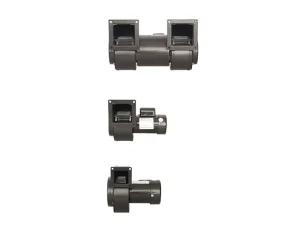
CE Certification Industrial Air Cooling Fan Manufacturer, Factory Direct
Explore Model
China High Density Heating Element Manufacturers, Custom Factories
Explore Model
China Portable Ceramic Heaters for Industry Exporter & OEM Supplier
Explore Model
CE Certification PVC-O Ovens for Precision Pipe Heating System
Explore Model
CE Certification Explosion Proof Electric Heater Exporter, Heavy Industry
Explore Model
CE Certification Efficient Air Duct Heaters for HVAC & Process Lines
Explore ModelCommercial & Industrial Landscape of Cast-In Ring Heaters
A technical examination into why high-throughput extrusion lines and high-temperature polymer processing rely on cast-in aluminum and bronze metallurgy.
Thermal Density & Heat Dissipation
Cast aluminum heaters provide continuous sheath operating temperatures up to 350°C (662°F), with maximum watt densities reaching 35–45 W/in². Cast bronze and brass alloys extend this envelope up to 650°C (1200°F) for fluoropolymers and PEEK processing, preventing hot-spot degradation across cyclic thermal loads.
CE Normative Compliance & Dielectric Safety
Compliance with the Low Voltage Directive (LVD) 2014/35/EU and Machinery Directive 2006/42/EC mandates rigorous insulation resistance (>100 MΩ at 1000V DC) and breakdown voltage validation (up to 2500V AC). Cast-in elements completely eliminate air gaps, preventing internal oxidation and dielectric flashover.
Integrated Dual-Circuit Cooling Systems
Extrusion shear generation requires rapid cooling response. Our cast rings integrate seamless stainless steel (AISI 316L/304) or Incoloy cooling tubes directly within the cast matrix, delivering dual-function heating/cooling systems that maintain melt temperatures within ±1°C.
Cast Aluminum vs. Cast Bronze / Brass Alloy Matrix
A metallurgical guide for plastics process engineers, mold designers, and procurement managers specifying barrel heating components.
| Performance Metric | Cast Aluminum Alloy (Al-Si / Al-Cu) | Cast Bronze / Brass (Cu-Sn / Cu-Zn) | Engineering Selection Criteria |
|---|---|---|---|
| Maximum Working Sheath Temp | Up to 350°C (662°F) continuous | Up to 650°C (1200°F) continuous | Bronze is required for high-melt polymers like PEEK, PTFE, and PPS. |
| Thermal Conductivity (k) | 160 – 200 W/(m·K) (Rapid heat transfer) | 60 – 110 W/(m·K) (Moderate heat transfer) | Aluminum optimizes fast cycle ramp-ups and dynamic extrusion cooling. |
| Mechanical & Wear Durability | Moderate structural strength; ductile | Extremely high tensile strength; impact-resistant | Bronze resists abrasive, high-pressure die/blow-mold environments. |
| Permissible Watt Density | Up to 45 W/in² (7 W/cm²) | Up to 60 W/in² (9.3 W/cm²) | Bronze sustains compact physical footprints with intense power outputs. |
| Chemical & Corrosion Resistance | Standard resistance; susceptible to caustics | Superior against acidic polymer outgassing | Select bronze for processing halogenated resins, PVC, and PVDF. |
| Typical Industrial Equipment | Twin-screw extruders, blown film, laminators | Hot runner manifolds, die heads, injection nozzles | Aluminum for barrel zones; bronze for tight, high-wear zones. |
Macro Industrial Solutions & Localized Deployments
Addressing structural thermo-mechanical challenges across worldwide plastics processing and chemical engineering installations.
Polymer Extrusion & Compounding
Engineered for twin-screw compounding lines in Germany, the USA, and China. Cast aluminum ring heaters with dual helical cooling channels control exothermic heat surges, safeguarding polymer molecular integrity.
PVC-O & Precision Pipe Biaxial Drawing
Integrated with Kangpu's patented precision heating systems and PVC-O ovens, providing isothermal radial profiles required for high-tenacity, molecularly oriented pressure pipes.
Die Heads & Blow Molding
Heavy-duty bronze cast rings withstand the clamping pressures, high thermal shocks, and corrosive polymer release agents encountered in large-scale hollow container production.
Semiconductor & Clean Steam Systems
Cleanroom-certified cast heaters utilized in vacuum chambers and non-combustion steam generation, preventing particulate contamination while ensuring strict heat containment.
Technical Roadmap: Smart Foundry & Thermal Efficiency
Driving industrial decarbonization through advanced metallics, computer-aided foundry simulations, and closed-loop IoT temperature monitoring.
Zero-Porosity Gravity & Vacuum Die Casting
Traditional sand casting often suffers from micro-porosity and trapped inclusions, resulting in localized hot spots and early element burn-out. Kangpu employs vacuum-assisted gravity die casting to guarantee dense, homogenous alloy structure and high heat conductivity.
Aerogel Hybrid Insulation Integration
To meet global carbon neutral initiatives, next-generation cast assemblies combine internal cast heating bands with custom engineered ceramic fiber or aerogel insulation outer shells, dropping external skin temperatures below 60°C and cutting power usage by up to 30%.
Embedded Edge-Sensing & Predictive Maintenance
Incorporating dual duplex mineral-insulated Type J/K thermocouples directly into the casting mold allows real-time sheath vs. barrel boundary diagnostics, interfacing directly with Industry 4.0 PLC controllers to flag degradation before operational downtime occurs.
Cast Heater Engineering FAQ
Key technical answers for process engineers, plant buyers, and thermal systems builders.
Industrial Heating Systems & Thermal Controllers
Explore certified temperature management machinery, auxiliary cooling loops, and high-performance replacement bands engineered in Jiangsu, China.

CE Certification Flexible Heaters for Custom Industrial Applications
Explore Model
Best Infrared Ceramic Heaters for Efficient Radiant Heating Solutions
Explore Model
CE Certification Precise Cooling and Heating System for Extruders
Explore Model
High-Quality Thermocouple Sensors Exporter & Direct Factory
Explore Model
CE Certification Electromagnetic Induction Heater Energy-Saving Unit
Explore Model
High-Quality Portable Ceramic Heaters for Industry - Reliable Heating Solutions
Explore Model
High-Quality (Hot-runner) Spring Heater / Coil Heater Manufacturers
Explore Model