Primary Industrial Thermal Systems & Heaters
Engineered to meet stringent European Pressure Equipment Directive (PED) and CE standards with verified operational safety.



Engineering Architecture: CE Certification & Technical Superiority
A comprehensive examination of why thermal fluid circulation systems demand stringent structural safety, specialized welding verification, and precision control algorithms.
CE Pressure Equipment Directive (PED) Compliance
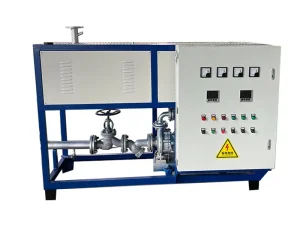
Thermal fluid heaters operate under high thermal stress. Our CE-certified heat-conducting oil furnaces adhere strictly to Directive 2014/68/EU Module H/H1, encompassing seamless tube non-destructive testing (NDT), X-ray weld inspection, and certified burst-pressure hydrostatic evaluations to ensure zero thermal cracking risks under cyclic loads.
Advanced Flow Hydrodynamics & Anti-Coking
Coking along heating elements significantly degrades heat transfer and introduces local overheating hazards. Kangpu furnaces integrate precision calculated heat flux rates (maintaining < 2.5 W/cm²) and optimized multi-loop coil geometry, guaranteeing turbulent Reynolds numbers (>10,000) that preserve heat transfer fluid molecular longevity beyond 50,000 running hours.
Intelligent Dual-PID Micro-Modulation
Equipped with dual-loop silicon controlled rectifier (SCR) power regulating modules, our systems avoid high-amplitude switching shock. Coupled with high-accuracy RTD sensors, the thermal controller balances heating and cooling phases seamlessly, achieving tight delta-T stability indispensable for composite curing and precision polymers.
Strategic Supply Chain & Manufacturing Dominance
Harnessing China's premier industrial heating manufacturing cluster in Yancheng to deliver uncompromised quality and lead-time agility.
Full-Spectrum In-House Fabrication
From deep-drawing expansion tanks and robotic submerged-arc welding to precision high-temperature element bending, our Yancheng facility eliminates subcontracting delays. Direct access to raw structural stainless steels (SUS304/SUS316L/SUS310S) ensures optimal cost-to-performance ratios for global contractors.
Engineered Traceability & Component Origin
Every furnace assembly incorporates Tier-1 European standard electrical architecture (Schneider, ABB contactors, Siemens PLC interfaces, and SPECK magnetic drive pumps). Our certified production protocols include complete material mill test certificates (MTC) according to EN 10204 3.1 standards.
Fast Modular Scalability & OEM Turnarounds
Our modular skid-mounted architectures enable seamless plug-and-play field deployment. Engineering modifications (custom voltage ratings from 208V to 690V, ATEX/IECEx explosion-proof configurations, and dual-zone manifolds) transition from ID designs to functional samples within 15 working days.
Global Enterprise Procurement Dynamics & Future Trends
Addressing the shifting landscape of industrial heating: electrification, energy decarbonization, and smart digital predictive twins.
Total Cost of Ownership (TCO) Prioritization
Global procurement teams in North America, Western Europe, and Southeast Asia have transitioned from low-capex mindsets to operational lifecycle evaluations. An efficient heat-conducting oil furnace minimizes downtime through non-contact magnetic seal-less pumps, optimized insulation blankets, and high thermal efficiency exceeding 98%.
Electrification vs. Combustion Systems
With stringent global carbon taxation and ESG reporting mandates, industrial operators are actively phasing out gas- and diesel-fired thermal oil heaters. Electric heat-conducting oil furnaces offer zero localized greenhouse gas emissions, low operational decibels, compact footprint footprints, and compatibility with factory solar arrays.
Industry 4.0 & Predictive Maintenance
Modern international buyers require seamless SCADA integration via Profinet, Modbus-TCP, or EtherNet/IP. Our current generation systems feature remote IoT telematics that continuously monitor oil viscosity trends, flow differential pressures, and sheath surface temperatures to predict maintenance cycles before failure occurs.
Localized Applications & Worldwide Engineering Support
Custom-adapted thermal configurations serving mission-critical process plants across more than 100 industrial regions.
Composite Curing & Autoclave Tooling
Supplying high-stability closed-loop fluid heating to carbon fiber platen presses in aerospace and automotive sectors, preventing matrix warpage through uniform temperature fields within critical structural tolerances.
Chemical Synthesis & Jacket Reactors
Providing rapid-response heating and cooling cycling for pharmaceutical synthesizers and polymerization reactors, avoiding thermal inertia runaways through dedicated auxiliary bypass exchangers.
Continuous Calendering & Lamination
Maintaining micro-accurate surface heat across textile lamination drums, rubber vulcanizers, and non-woven film rollers where temperature variations produce severe membrane thickness defects.
Localized Compliance & Regional Field Support
We supply bespoke bilingual electrical schematics, complete documentation dossiers (FAT/SAT protocols), standardized metric/imperial flange connections, and pre-commissioned skid packages backed by global rapid-response parts dispatch.
Expertise & Procurement FAQ
In-depth responses to critical technical queries frequently raised by EPC contractors, plant managers, and procurement specialists.
What specific testing validates CE certification for your heat-conducting oil furnaces?
Every oil furnace model exported to Europe is built strictly under the European Pressure Equipment Directive (PED 2014/68/EU). Testing encompasses 100% radiographic or ultrasonic examination of high-pressure welds, third-party hydrostatic pressure testing at 1.5 times the maximum allowable design pressure, insulation resistance testing under high thermal loads, and safety shut-off validation on low-level expansion switches and over-temperature interlocks.
How do electric heat-conducting oil furnaces prevent thermal fluid degradation?
Thermal fluid breakdown (coking and cracking) occurs when the fluid film temperature exceeds manufacturer recommendations. Kangpu solves this through precision watt-density throttling (typically maintaining sheath watt densities below 2.0 to 2.5 W/cm² depending on the specific synthetic or mineral oil), coupled with variable-frequency driven high-velocity circulation pumps that maintain uniform turbulent boundary layers across all heating elements.
What is your policy regarding custom engineering designs, OEM branding, and voltage compatibility?
Our core operational model revolves around tailored engineering. Following our 7-stage development process (ID Design, Product Customization, Real-Mold Sampling, Confirmation, Modification, Rigorous Testing, and Mass Production), we engineer systems specifically adapted to local three-phase grids (such as 380V/50Hz for Europe/China, 480V/60Hz for the Americas, or 415V/50Hz for Commonwealth markets), with custom footprint, piping configurations, and private-label OEM enclosures.
What after-sales warranty and spare parts support is offered to international buyers?
Unlike standard trading operations, Kangpu offers a comprehensive 5-year warranty on core elements and fabrication structures. Every unit manufactured carries an individual serialization batch tag allowing permanent traceability of weld batches, raw materials, and electrical sub-components. Spare parts packages (including custom flange gaskets, heating bundles, and solid-state relays) are available for international air-freight dispatch within 48 hours.
Can Kangpu systems manage both heating and precision cooling cycles within a unified circuit?
Yes. Our patented precise heating and cooling integrated systems utilize dual-channel or plate heat-exchanger skid loops. The PLC automatically modulates the heating element bank and proportional cooling water valves, enabling controlled ramp, soak, and quench profiles without inducing thermal shock to sensitive molding dies or reactor jackets.
Specialized Thermal & Precision Extrusion Equipment
Explore our certified portfolio of heavy-duty industrial band heaters, ovens, and thermal oil process machinery.