
Certified Industrial Heating Portfolio (Part I)






State of the Industry: The Shift Toward Conformable Thermal Systems
In modern thermodynamic engineering, the boundary between the heating element and the targeted component determines thermodynamic efficiency, thermal ramp speed, and system lifespan. Traditional rigid tubular, cast-in, and heavy mica elements frequently suffer from microscopic interfacial air gaps. These micro-voids present thermal impedance, forcing resistive core wires to run at excessively high internal temperatures to overcome conductive resistance, thereby accelerating dielectric breakdown and causing thermal runaway.
Industrial flexible heaters represent an evolutionary leap forward. Originating from high-reliability aerospace and avionics research, these flexible architectures utilize thin, elastomeric, polymeric, or knitted ceramic matrices that geometrically conform directly to cylindrical, conical, spherical, or complex polygonal contours. By minimizing interfacial boundary layer resistance, a flexible heater transfers heat directly via intimate conduction, enabling substantially lower element core temperatures, enhanced watt-density efficiency (up to 12 W/cm² depending on the dielectric substrate), and micron-level temperature uniformity across expansive surface areas.
As an established OEM/ODM factory operating since 1986 under the brand Kangpu Heater (Yancheng Laier Heating Technology Co., Ltd.), we design and produce high-performance industrial flexible heating elements engineered to conform to strict European Directives, including Low Voltage Directive (LVD) 2014/35/EU, Electromagnetic Compatibility (EMC) 2014/30/EU, and harmonized standards EN 60335-1 and EN 60519-1/2.
Silicone Rubber Flexible Heaters
Fiberglass-reinforced silicone rubber vulcanized over etched foil or precision-wound resistance alloys. Resilient against moisture, industrial chemicals, and thermal shock.
- Operating range: -60°C to +235°C continuous
- Dielectric withstand: Up to 2,000 VAC
- Watertight, chemical-resistant IP65/IP67
- Thickness: 1.2 mm to 1.8 mm profile
Polyimide (Kapton®) Thin-Film Heaters
Ultra-thin, featherlight polyimide film encapsulates micro-etched foil circuits. Exceptional mechanical stability, ultra-low outgassing, and sub-millimeter bend radii.
- Operating range: -200°C to +200°C
- Ultra-thin profile: < 0.25 mm overall
- Excellent for ultra-high vacuum (UHV)
- Rapid thermal cycling response (< 1s)
Flexible Ceramic Pad & Blanket Heaters
High-alumina ceramic beads laced with 80/20 Nickel-Chromium stranded wire, forming a heavy-duty, highly flexible thermal pad for post-weld heat treatment (PWHT).
- Operating limits: Up to 1,050°C continuous
- High mechanical abrasion durability
- Custom interlocking ceramic bead geometry
- Modular power linking for large pressure vessels
Engineering Evaluation Matrix: Flexible Substrate Comparison
| Substrate Material | Continuous Temp. Limit | Max Watt Density | Dielectric Breakdown | Flexibility / Min. Bend Radius | CE & Environmental Rating |
|---|---|---|---|---|---|
| Silicone Rubber (Reinforced) | -60°C to +235°C | 0.8 – 1.2 W/cm² | > 16 kV/mm | R = 3.2 mm (Dynamic or static) | EN 60335-1 / IP67 / RoHS |
| Polyimide Film (Kapton®) | -200°C to +200°C | 0.6 – 1.5 W/cm² | > 150 kV/mm | R = 0.8 mm (Ultra-compact) | CE LVD / NASA Outgassing |
| Flexible Ceramic Pad (FCP) | Up to 1,050°C | 6.0 – 9.5 W/cm² | > 5 kV/mm (Dry Alumina) | R = 25 mm (Cylindrical wrap) | EN 60519-1 / Heavy PWHT |
| PTFE / Fluoropolymer Film | -150°C to +260°C | 0.5 – 0.9 W/cm² | > 40 kV/mm | R = 5.0 mm (Corrosion proof) | CE / Wet Chemical / Acid Immersion |
| Mica-Composite Flex Sheet | Up to 500°C | 2.5 – 4.5 W/cm² | > 20 kV/mm | R = 15 mm (Semi-rigid band) | CE Industrial Nozzle Spec |
Global Enterprise Procurement Requirements: Beyond Basic Wattage
Procuring industrial heating components for continuous production lines is fundamentally an evaluation of risk mitigation. When a flexible heating element fails on an automated extrusion barrel, an analytic spectrometer, or an aerospace composite autoclave, the direct cost of the replacement heater is negligible compared to unplanned line stoppage, scrap generation, and delayed shipment penalties.
Global procurement executives prioritize six essential technical parameters when qualifying an industrial flexible heater manufacturer:
Thermal Uniformity & Profiling
Uniform heat flux across complex geometries without edge-effect cold zones or localized hotspot degradation. Custom-etched foil layouts provide differentiated localized watt densities where conductive heat dissipation is uneven.
Dielectric Integrity & Safety Compliance
Uncompromising compliance with CE Directive 2014/35/EU, verified by high-potential (Hi-Pot) insulation breakdown testing (standard 1,500V to 2,500V test sequences) and leakage current measurements below 0.25 mA.
Mechanical & Environmental Resilience
Robust vulcanized transitions between internal resistance elements and external power leads. Strain relief ratings engineered to resist cyclic machine vibration, bending fatigue, and exposure to oils, solvents, and moisture.
Integrated Sensing & Control Feedback
Factory-integrated thermocouples (Type K, J, PT100, NTC thermistors) or thermal cutoffs placed precisely within the heating layer to provide responsive, millisecond-accurate closed-loop control.
Mounting Modality Flexibility
Turnkey factory integration of pressure-sensitive adhesive (PSA like 3M 467MP/468MP), silicone RTV bonding systems, mechanical eyelets, Velcro straps, latching springs, or magnetic backings to match customer field maintenance schedules.
Full Traceability & Warranty Coverage
Complete lot-specific raw material certification (resistance wire alloy analysis, silicone purity) and serial-number-backed quality records, backed by our 5-year after-sales warranty.
Macro-Industry Engineering Solutions
Plastics Machinery, Extrusion & Injection
In polymer processing, barrel and die head thermal stability determines melt viscosity, plasticization homogeneity, and crystalline wall structure. Kangpu designs flexible silicone band heaters, combined heating/cooling jackets, and insulating covers that eliminate cold-spots on feed throats and barrel sections.
Particularly in PVC-O orientation ovens and multi-layer pipe lines, our high-density flexible elements deliver precise +/-1.5°C tolerance windows, preventing polymer degradation and reducing line power consumption by up to 28% compared to non-insulated rigid bands.
Semiconductor Processing & Vacuum Chambers
Sub-micron semiconductor manufacturing and vacuum deposition require ultra-clean, bake-out thermal systems. We produce polyimide etched-foil heating mantles and silicone bake-out jackets with virtually zero organic outgassing under high vacuum (10⁻⁶ Torr).
Our low-profile flexible elements wrap tightly around forelines, exhaust pipes, vacuum valves, and wafer chuck assemblies, eliminating condensation of reactive process by-products like ammonium chloride or silane condensates.
Lithium-Ion Battery & Clean Energy Storage
Battery manufacturing demands precise drying during electrode slurry coating and controlled pre-heating during cell vacuum electrolyte filling. Kangpu builds custom flexible platen heaters that apply even thermal fluxes across wide conductive transfer surfaces.
Additionally, for cold-climate battery energy storage systems (BESS), our IP67-sealed flexible silicone heater mats provide automated frost protection, preventing catastrophic lithium plating during sub-zero charging cycles.
Medical Diagnostic & Analytical Instrumentation
Precision clinical chemistry analyzers, DNA amplification thermal cyclers, and blood warming equipment require instant thermal equilibration and zero acoustic/electrical interference.
Our CE-certified polyimide heating arrays provide micro-watt density distribution, fitting tight spaces around fluidic manifolds, reagent cuvettes, and patient delivery tubing with integrated PT1000 RTD micro-sensors.
Industrial Reliability Backed by 4 Decades of Production Know-How
Four full decades dedicated exclusively to industrial electric thermal engineering.
Direct factory supply to OEM equipment manufacturers across Europe, Americas & Asia.
Proprietary cooling/heating integrated assemblies and patented air-cooled barrel designs.
Full batch traceability and after-sales engineering accountability that outlasts industry norms.
Unlike trading companies that broker generic products, Kangpu Heater (Yancheng Laier Heating Technology Co., Ltd.) executes complete manufacturing vertically within our facility. Every industrial flexible heater order progresses through our rigorous 7-Stage Engineering Workflow:
- Stage 01: Industrial ID & Thermodynamic Design: Our engineers map mechanical interfaces, clamp geometries, lead exit orientations, and dielectric clearance margins.
- Stage 02: Electrical & Material Customization: Confirmation of operating voltages (12V to 600V), wattage density (W/cm²), resistance alloy grade (NiCr 80/20 vs CuNi), and lead insulation (Teflon, silicone, or braided fiberglass).
- Stage 03: Real-Mold Tooling Sample Fabrication: We open true production tooling dies rather than making rough hand-cut samples, ensuring prototypes precisely match production runs.
- Stage 04: Customer In-Situ Verification: Clients install initial qualification samples directly on operating machinery to evaluate fit, ramp-rate, and thermal consistency.
- Stage 05: Empirical Feedback & Iterative Modification: Fine-tuning lead wire angle, clamping spring tension, or localized heat zoning based on actual machine trial data.
- Stage 06: Comprehensive Electrical & Thermal Testing: Hi-pot testing (up to 2,500V), insulation resistance testing (> 100MΩ at 500VDC), thermal imaging IR scan, and immersion leak testing.
- Stage 07: CE-Compliant Mass Production & Packaging: Full production release with lot serial assignment, vacuum/protective packaging, and global dispatch.
Technology Roadmap: The Next Generation of Flexible Heating
01 / Embedded Optical Fiber & Multi-Zone Sensing
Integrating Fiber Bragg Grating (FBG) optical sensors directly within the flexible elastomer substrate. This enables distributed temperature sensing across hundreds of discrete points along a single optical fiber, replacing bulky discrete thermocouples and eliminating electromagnetic noise interference in RF and plasma environments.
02 / Graphene & Carbon Nanotube Conductive Matrices
Transitioning beyond standard metallic wire winding to printed graphene ink and carbon nanotube (CNT) conductive films. These materials provide virtually instantaneous infrared radiative emission, near-zero thermal inertia, and extreme fatigue resistance over hundreds of thousands of dynamic bending cycles.
03 / Self-Regulating PTC Polymeric Blends
Engineering flexible heaters with conductive carbon-doped polymer matrices displaying positive temperature coefficient (PTC) characteristics. As local temperatures rise, electrical resistance increases exponentially, providing inherent, fail-safe overheat protection without requiring auxiliary external controllers.
Technical FAQ: Engineering, Standards & Customization
How does Kangpu guarantee CE compliance for industrial flexible heaters?
Our manufacturing processes conform to the European Low Voltage Directive (LVD) 2014/35/EU and harmonized standards EN 60335-1 (Safety of household and similar electrical appliances) and EN 60519-1/2 (Safety in electroheat installations). Each batch undergoes 100% dielectric withstand testing at 1,500V–2,500V, insulation resistance verification (>100MΩ at 500VDC), and earth continuity testing. Full Declaration of Conformity (DoC) and test reports are provided with commercial shipments.
What is the maximum permissible watt density for flexible silicone heaters?
For continuous operation, standard reinforced silicone rubber heaters are rated up to 0.8 to 1.2 W/cm² when securely clamped or bonded using high-temperature acrylic or silicone PSA adhesive to a metal heatsink. If utilized in intermittent duty or dynamic control systems with responsive feedback sensors, higher watt densities can be evaluated. In contrast, polyimide Kapton heaters can support up to 1.5 W/cm², while flexible ceramic pads (FCP) achieve up to 9.5 W/cm².
How does Kangpu handle lead wire strain relief and moisture ingress protection?
Lead wire connection points represent the most vulnerable interface on any flexible heater. We utilize high-pressure vulcanized silicone transition boots that encapsulate the junction between the heating alloy and external leads (PTFE, silicone, or fiberglass insulated). This achieves a completely hermetic seal rated up to IP65 or IP67, protecting the internal element from oil, water, and plasticizer degradation while withstanding mechanical pull forces exceeding 150N.
Can you customize localized watt densities across a single continuous heater?
Yes. Through computer-aided photochemical etching, our engineers design resistance circuits with varying track widths and spacing across different zones of the same element. This allows us to compensate for structural heat loss—for example, concentrating higher watt density along the outer edges of a plate or cylinder while reducing power density at the insulated center, achieving uniform surface temperatures across the entire assembly.
What is the standard production lead time for custom tooling and mass supply?
Standard custom CAD design and real-mold sampling require 5 to 8 working days. Once the sample has been tested and approved on your machinery, mass production orders (ranging from 100 to 10,000 units) are typically completed within 14 to 21 working days. We also support Kanban buffer inventory arrangements for long-term Tier-1 OEM partners to enable just-in-time dispatch.
What does your 5-year after-sales warranty cover?
Our five-year warranty covers all structural defects, dielectric breakdown under specified operating conditions, and material delamination. Every manufactured unit carries a laser-etched or vulcanized serial number linked to our factory raw material batch, production operator, and testing bench logs. If an unexpected failure occurs, we analyze the root cause at the material level and replace the element without production-delaying disputes.
Certified Industrial Heating Portfolio (Part II)






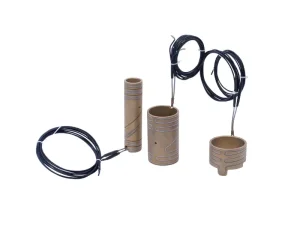
Consult with Kangpu's Thermal Engineers on Your Custom Heating Application
Whether you need a replacement flexible heater engineered to existing machinery dimensions or a complete custom heating and cooling system for a new OEM line, our team in Yancheng will evaluate your drawings, CAD files, or technical specifications within 24 hours.