Featured Industrial Heating Elements & Precision Systems
Factory-direct thermal engineering components built in strict accordance with ISO 9001 quality management and CE electrotechnical standards.





The Global Industrial Landscape of Large Infrared Heating Systems
Across North America, the European Union, and Asia-Pacific manufacturing belts, high-energy thermal processing is undergoing a structural paradigm shift from legacy convective heating toward directional electromagnetic radiative heat transfer.
Radiative Efficiency & Energy Decoupling
Convective hot-air ovens experience substantial thermodynamic loss via ambient boundary-layer resistance and duct dissipation. In contrast, medium-wave (1.4 – 3.0 µm) and long-wave (> 3.0 µm) large infrared heaters transfer thermal kinetic energy directly into polymer matrices, composite laminates, and metal coatings. This molecular resonance achieves radiant conversion efficiencies exceeding 92%, substantially lowering baseline kWh consumption.
Stringent CE Compliance Architecture
Exporting large-scale infrared radiators and barrel heaters to European markets demands uncompromising adherence to the Low Voltage Directive (LVD 2014/35/EU) and Electromagnetic Compatibility Directive (EMC 2014/30/EU). Certified units must guarantee creepage/clearance safety up to 1000V AC, high-pot insulation resistance exceeding 100MΩ at 1500V test loads, and complete suppression of transient harmonic distortions.
Thermal Response & Closed-Loop Control
Modern plastics extrusion, thermoforming, and web-curing operations cannot tolerate high thermal inertia. Large nano-infrared and ceramic radiative arrays provide rapid ramp-up curves—reaching target thermal equilibrium in under 8 minutes. Coupled with integrated Type K/J thermocouples, PID solid-state relay controllers maintain surface tolerances within ±1.5°C across massive barrel lengths.
Chinese Factory Efficiency: The Yancheng Industrial Cluster Advantage
Based in Yancheng, Jiangsu Province—the heartland of China's advanced electric heating industry—Kangpu Heater (Yancheng Laier Heating Technology) combines end-to-end component metallurgy with high-velocity CNC manufacturing.
Full Metallurgy & Die-Casting Integration
Unlike regional assemblers reliant on third-party raw elements, our facility processes resistance nickel-chromium wiring (Cr20Ni80), high-purity electro-melted magnesium oxide (MgO), and cast aluminum/copper alloys under unified internal metallurgical supervision. This eliminates interface thermal resistances and prevents early element burnout.
Real-Mold Rapid Prototyping
Precision procurement demands exact form fitting. Our 7-stage custom manufacturing process bypasses inaccurate hand-formed mockups, utilizing production-grade tooling directly during sample validation. This cuts sample lead times from standard 6-week industry averages down to 7–10 days.
Total Cost of Ownership (TCO) Compression
By optimizing radiant aerodynamic shrouds and aerogel-composite insulation jackets, Kangpu large infrared systems eliminate radiant waste heat in factory ambients. Air conditioning refrigeration loads drop by 20–30%, while extruder heat-up electricity drops by up to 35%, ensuring complete payback within 6–12 operating months.
Mission-Critical Deployment Scenarios Across Global Heavy Industry
Large infrared and specialized electric heaters operate under rigorous industrial stress. Below is our engineering breakdown of actual production deployments:
1. High-Output Polymer Extrusion & Masterbatch Lines
On twin-screw and high-torque single-screw extruders (processing PP, PE, PA66, and PTFE), conventional band heaters create localized hotspots that degrade shear-sensitive polymers. Large nano-infrared band heaters deliver homogeneous circumferential flux. Infrared radiation penetrates deep into the barrel core, liquefying melt streams evenly without inducing localized resin degradation.
2. Biaxially Oriented PVC-O Pipe Conditioning
Molecular orientation of polyvinyl chloride (PVC-O) pipe requires continuous temperature soaking within an exceptionally narrow viscoelastic window (±1.0°C). Kangpu PVC-O heating ovens utilize multipoint-controlled large infrared elements, preventing structural micro-cracking and ensuring maximum hoop tensile strength in water infrastructure pipe lines.
3. Industrial Curing, Thermoforming & Web Processing
For composite prepreg curing, continuous automotive sheet coating, and thermoforming plastic blisters, large infrared arrays transfer instantaneous infrared power that matches the exact chemical absorption spectra of water and polymer resins. Surface curing times are cut by over 50% compared to recirculating convective tunnels.
4. Non-Combustion Indirect Thermal Oil & Steam Systems
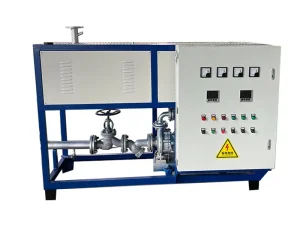
Chemical reactors, calendar rolls, and cleanroom vulcanization systems facing strict zero-carbon mandates replace gas boilers with Kangpu high-power electromagnetic steam boilers and electric thermal oil furnaces. The system eliminates fossil combustion hazards, burner maintenance, and flue heat dissipation entirely.
Industrial Heating Technology Selection Matrix
A direct technical comparison to assist engineering teams and procurement directors in selecting optimal heating architectures for their line equipment.
| Heating Technology | Primary Heat Transfer | Surface Temp Range | Thermal Efficiency | Typical Industrial Fitment |
|---|---|---|---|---|
| Large Nano-Infrared Band | Radiation (Infrared 2–10 µm) | Up to 500°C | 90% – 95% | Energy-saving extruder retrofits, barrel thermal zones |
| Engineered Ceramic Band | Conduction + Secondary Radiation | Up to 700°C | 80% – 85% | Extruder cylinders, blow molding heads, high-temp barrels |
| Cast Aluminum / Copper | Direct Solid Conduction | Al: 350°C / Cu: 650°C | 75% – 82% | Precision cooling/heating extrusion systems, heavy dies |
| Precision Mica Band | Surface Contact Conduction | Up to 350°C | 70% – 75% | Injection molding nozzles, small blow nozzles, thin dies |
| Air Duct Process Heaters | Forced Convection | Up to 600°C | 78% – 84% | HVAC drying, continuous tunnel ovens, air preheating |
Future Trends & Global Strategic Procurement Criteria
Corporate ESG mandates, EU Carbon Border Adjustment Mechanism (CBAM) pressures, and Industry 4.0 automation are redefining how tier-1 manufacturers evaluate heating systems.
1. IoT-Enabled Diagnostic Heaters
Predictive maintenance is replacing reactive replacement. Next-generation infrared and cast-in assemblies feature embedded RTD sensors and micro-transmitters that continuously log leakage currents, element impedance drift, and sheath thermal strain back to central SCADA and MES dashboards.
2. Hybrid Heating-Cooling Synergy
Exothermic polymers in high-output extruders require violent cooling right after initialization. Our patented integrated air-cooled heating system harmonizes stainless steel blower shrouds with high-efficiency ceramic or cast-in elements, eliminating cyclical thermal overshoot and screw wear.
3. Strict Supply Traceability & Batch Records
International procurement groups now reject unbranded components lacking material certificates. Kangpu maintains full heat-number traceability for stainless steel sheathing (AISI 304/316L/Incoloy 800), resistance wire alloy batches, and electrical insulation tests under our 5-year warranty protocol.
Frequently Asked Questions (FAQ) for Engineering & Sourcing
Real technical and commercial inquiries answered by Kangpu's thermal engineering team.
What specific CE directives do Kangpu large infrared and industrial heaters satisfy?
Kangpu heaters fully comply with the European Union Low Voltage Directive (LVD) 2014/35/EU and the Electromagnetic Compatibility Directive (EMC) 2014/30/EU. All components undergo standardized dielectrical strength tests (1500V/min with zero breakdown), cold and hot insulation resistance verification (>100MΩ), and earth ground continuity screening under EN 60335-1 and EN 60519-1 regulations.
Can Kangpu reverse-engineer heaters from worn machine samples or CAD blueprints?
Yes. Custom OEM/ODM engineering accounts for over 85% of our production volume. Clients can provide STEP, DWG, or PDF schematics, or ship worn physical samples to our Yancheng facility. Our engineering department verifies barrel diameters, cutouts, thermocouple probe wells, lead terminal box clearances, and watt density profiles before tooling production-ready molds.
How does a nano-infrared band heater achieve 30%+ energy savings over mica/ceramic bands?
Conventional band heaters operate primarily by contact thermal conduction, meaning that 40–50% of the generated energy radiates outward into the factory air. Nano-infrared heaters utilize high-emissivity ceramic-doped alloy filaments that convert electricity into targeted directional infrared waves. An aerogel-insulated outer reflective shroud blocks outward radiant loss, keeping outer casing temperatures below 50–70°C while heating the cylinder intensely.
What quality assurance process backs your 5-year industrial warranty?
Every single heater undergoes 100% factory verification: resistance tolerance check (within ±5%), insulation resistance under both ambient and saturated steam states, and dimension CMM measurement. Each unit receives a permanent laser-etched serial code. If an element degrades prematurely, our laboratory cross-references the metallurgical lot and operating logs to rectify the root thermal mechanics.
What is your typical production turnaround for custom export orders?
Because we control all fundamental tooling, ceramic forming, and alloy die-casting on site, custom real-mold prototypes are completed and tested within 7 to 10 working days. Full container load (FCL) or standard LCL mass production orders generally ship within 15 to 25 days, packaged in seaworthy, moisture-proof, export-grade wooden crating.
Which terminal connection options are available for harsh or corrosive environments?
We supply terminal configurations engineered for diverse industrial exposures: high-temperature ceramic terminal blocks, stainless steel terminal boxes (IP55/IP65 rated), explosion-proof junction housings, braided fiberglass high-temp nickel leads, and European standard plug configurations (Harting / DIN industrial standards).
Advanced Industrial Thermal Hardware & Process Assemblies
Explore further specialized heating modules, heavy-duty boilers, and precision sensors designed for seamless integration into demanding industrial operations.