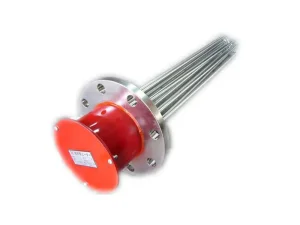
High-Efficiency Process Heating & Thermal Control Systems
Explore precision-engineered radiant emitters, thermal fluid circulation units, and process heating systems compliant with EU Machinery and Low Voltage Directives.




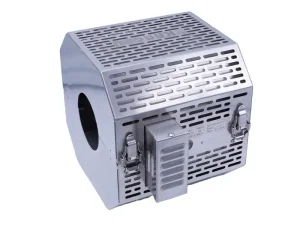



Radiant Process Heating: Thermodynamics, Electromagnetic Theory & Industrial Decarbonization
As modern manufacturing pivots toward stringent ESG benchmarks and low-carbon thermal processing, radiant process heaters have emerged as the paramount thermal platform across polymer processing, semiconductor annealing, web converting, and chemical processing. Unlike convective or conductive systems that depend on intermediate physical media, radiant heaters exploit targeted electromagnetic radiation in the infrared band (1.2 μm to 10.0 μm) to achieve near-instantaneous heat transfer directly into the product core.
Fundamental Heat Flux Governed by the Stefan-Boltzmann Relationship: Radiant heat flux ($q$) is proportional to the difference of fourth powers of absolute temperature: $q = \varepsilon \sigma (T_{emitter}^4 - T_{target}^4)$, where $\sigma$ is the Stefan-Boltzmann constant ($5.670 \times 10^{-8} \text{ W/m}^2\text{K}^4$) and $\varepsilon$ is the surface emissivity. By engineering high-emissivity ceramic refractory matrices ($\varepsilon \ge 0.94$) combined with high-grade FeCrAl (Kanthal) and NiCr resistance alloys, Kangpu radiant process systems eliminate convection delay, reducing electrical consumption by 28% to 42% compared to conventional resistive elements.
Spectral Matching & Absorption Band Optimization
The core breakthrough in our CE-certified radiant process heaters lies in spectral wavelength tuning. Polymers, composite matrices, and solvent-based paints possess distinct molecular absorption peaks primarily governed by C-H, O-H, and C=O harmonic stretches within the 2.5 μm to 6.0 μm infrared domain. Conventional tubular heaters produce indiscriminate broadband thermal output that dissipates into ambient boundary layers. Kangpu's ceramic-embedded and nano-infrared radiant designs precisely match the emitter output to the target material's infrared absorption band, delivering superior penetration depth and avoiding surface skinning, blister defects, or internal stress formation in high-throughput production lines.
Macro-Industry Thermal Solutions Engineered for Scale
From advanced polymer compounding to continuous metal coil coating, our CE-marked radiant and hybrid heating architectures resolve critical bottleneck operations.
Polymer Extrusion & PVC-O Orientation
Thermal stability across long barrel lengths is essential for molecularly oriented PVC pipe production. Our patented air-cooling integrated radiant jackets and custom PVC-O ovens maintain micro-zone temperature profiles within ±0.5°C, preventing melt degradation, thermal shock, and wall-thickness variation.
Petrochemical & Hazardous Zones
Flameproof and explosion-proof (ATEX/IECEx compliant) process radiant bundles engineered for preheating heavy hydrocarbons, bitumen de-visbreaking, and catalytic regeneration. Heavy-walled 316Ti / Incoloy 840 sheathings withstand sour gas and cyclic pressure transients.
Continuous Web Drying & Curing
In high-speed roll-to-roll conversion, battery electrode slurry drying, and technical textile coating, radiant panels deliver immediate zone throttling with negligible thermal inertia. Eliminates drying defects and allows automated rapid line-stop cooling without burn marks.
High-Purity Semiconductor & Cleanrooms
Electromagnetic induction steam generators and clean ceramic radiant arrays constructed from zero-outgassing high-alumina substrates. Certified for zero particulate generation, vacuum chamber wafer bake-out, and ultra-pure fluid thermal ramp cycles.
Technology Roadmap & Future Outlook: Towards Intelligent Thermal 4.0
Our long-term R&D trajectory integrates multi-physics modeling, wide-bandgap solid-state electronics, and advanced metamaterial coatings to push thermal transfer boundaries.
2026-2027: Graphene & Nano-Ceramic Composite Films
Commercialization of ultra-thin flexible radiant layers incorporating high-density carbon allotropes and SiC whiskers. Achieves thermal response rates under 1.5 seconds, emissivity coefficients exceeding 0.97, and surface uniformities of ±0.8°C across large format platen structures.
2027-2028: Edge-AI Autonomous Process Modulation
Integration of direct-on-emitter micro-thermocouple matrix arrays tied to on-board edge controllers. System algorithms leverage real-time emissivity feedback and digital twin thermal tracking to dynamically throttle power distribution zones before temperature overshoots occur.
2028-2030: Zero-Carbon Direct Radiant Electrification
Next-tier industrial megawatt electrification replacing fossil fuel gas-fired firing tunnels. Engineered with ultra-high density SiC/MoSi2 radiant bars up to 1600°C, offering heavy-duty ceramic insulation jackets and full compliance with Scope 1 carbon emission elimination directives.
China Factory 4.0: Supply Chain Resilience, Vertical Integration & Cost Leadership
Headquartered in Yancheng, Jiangsu—the epicentre of China's industrial electroheat manufacturing cluster—Kangpu pairs four decades of artisan engineering with high-precision automated execution.
The global industrial heating market has frequently suffered from fragmented supply chains, prolonged prototype cycles, and unreliable sub-supplier quality control. Kangpu eliminates these risks through deep vertical integration across our modern 25,000 m² production facility:
-
Precision CNC Metal Casting & Bending: In-house gravity die-casting and computerized bending machines for aluminum, brass, and copper sheathed radiant heaters.
-
Automated Resistance Wire Winding: CNC helical and flat winding ensuring consistent resistance values (±1.5%) and preventing localized hot-spot burnouts.
-
Ultra-Pure MgO Compaction: Automated dual-ram filling and swaging reaching dielectric compaction densities of >3.2 g/cm³ for extreme breakdown voltage ratings.
-
Automated Laser Welding & Hermetic Sealing: High-vacuum laser seam welding with high-temperature epoxy and glass-to-metal seals resisting humidity ingress.
| Engineering Attribute | Kangpu Factory 4.0 Standard | Standard Commercial Grade | Procurement Impact |
|---|---|---|---|
| Insulation Resistance (Cold) | > 1000 MΩ @ 1000V DC | > 50 MΩ @ 500V DC | Eliminates nuisance GFCI tripping in automated plants |
| High-Pot Dielectric Withstand | 2500V AC for 60s (Zero Breakdown) | 1500V AC for 60s | Superior surge protection during power grid spikes |
| Emitter Emissivity (ε) | 0.94 – 0.98 (λ = 2.0–10.0 μm) | 0.70 – 0.82 | Up to 32% lower energy draw for equivalent product temperature |
| Prototype to Sample Lead Time | 3 to 5 business days | 3 to 5 weeks | Dramatically accelerates OEM machinery commissioning |
| Traceability & QA | Laser QR code with full batch steel & wire data | Paper label / Batch estimate | Immediate root-cause identification under 5-year warranty |
Global Enterprise Sourcing: TCO, Risk Mitigation & CE Compliance Assurance
Purchasing process heating systems is a core reliability investment. A single heating element failure can trigger line halts costing upwards of $15,000 per hour in scrap and lost throughput.
Harmonized CE Compliance Framework
Every radiant heater exported from our Yancheng facility conforms rigorously to the European Low Voltage Directive (LVD 2014/35/EU), Electromagnetic Compatibility Directive (EMC 2014/30/EU), and EN 60519-1 (Safety in electroheat installations). Technical Construction Files (TCF) and Declarations of Conformity (DoC) accompany every shipment for seamless customs clearance.
Total Cost of Ownership (TCO) Model
Initial purchase price constitutes less than 7% of a process heater's lifecycle cost; energy consumption represents 86%, and downtime accounts for the remainder. Kangpu's precision ceramic insulation jackets, optimal watt density design, and extended MTBF (>35,000 continuous hours) lower the 5-year operating expenditure by up to 38%.
Localized Engineering & Export Support
Our multilingual thermal engineering desk provides direct technical alignment with plant engineers across North America, the European Union, Southeast Asia, and South America. We support dual-rated voltages (230V/400V/480V delta-wye configurations), regional terminal standardizations, and direct OEM drawing re-engineering.
Frequently Asked Questions: Technical Selection & Procurement
Authoritative answers curated by our chief thermal engineers covering certification, watt densities, lifetime extension, and custom manufacturing.
What specific standards govern your CE Certification for Radiant Process Heaters?
How does radiant infrared heating compare with conventional conduction band heaters on plastic extruders?
What is the standard sampling and custom tooling protocol for global OEM machinery builders?
How do you handle terminal box protection in high-vibration and humid industrial environments?
What warranty policy and batch traceability mechanisms support Kangpu heaters?
Specialized Thermal Elements, Induction Systems & Explosion-Proof Heaters
Complete your plant installation with CE-certified coil heaters, cast metal jackets, electromagnetic induction units, and hazardous-area heating elements.