
Featured High-Precision Heating Systems (Part I)
Explore our primary certified electric heating products engineered for high thermal efficiency, leak-proof nozzle operation, and exact process control across plastics machinery and industrial heating lines.





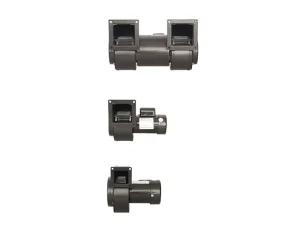

Global Commercial & Industrial Landscape of Cast Nozzle Heating
In modern polymer converting, injection molding, and continuous profile extrusion, thermal control at the machine nozzle boundary represents one of the most critical variables for product yield and resin integrity.
The global shift toward high-performance engineering thermoplastics—such as PEEK, PPS, PEI, and glass-filled Polyamides (PA66)—has drastically compressed the allowable thermal window during melt injection. Traditional sheet mica nozzle heaters often fail to maintain uniform peripheral heat transfer at elevated operating temperatures ($>300^\circ\text{C}$), leading to polymer drool, cold spots, premature sheath degradation, and frequent production line stoppages.
To overcome these mechanical and thermodynamic boundaries, global OEM equipment builders and Tier-1 processing plants rely on Cast Nozzle Heaters (precision-cast in aluminum, bronze, or copper alloys). By encapsulating high-grade Nickel-Chromium ($80/20$) heating elements within dense metallic matrices, cast nozzle heaters deliver uniform thermal distribution, robust physical protection against plastic contamination/blow-back, and extended operational lifespans under continuous heavy-duty cycles.
Metallurgical Precision & Thermal Conduction Engineering
Engineered heating elements are not merely resistive wires; they are thermodynamic conductors designed to optimize surface watt density and resist thermal degradation under high mechanical clamping pressures.
Cast Aluminum (Alloy AlSi12)
Ideal for standard injection molding nozzles and barrel zones requiring temperatures up to $350^\circ\text{C}$ ($662^\circ\text{F}$). Cast aluminum delivers exceptional thermal conductivity ($\sim 160\text{ W/m}\cdot\text{K}$), ensuring rapid thermal recovery during fast injection cycles while keeping heater weight minimal.
Cast Bronze & Copper Alloys
Engineered for ultra-high temperature applications reaching up to $650^\circ\text{C}$ ($1202^\circ\text{F}$). Cast bronze offers superior mechanical strength and thermal conductivity ($\sim 330\text{ W/m}\cdot\text{K}$ for copper), effectively eliminating hot-spot distortion under extreme nozzle contact pressures.
Hermetic Element Sealed Architecture
Incorporating compacted High-Purity Magnesium Oxide ($\text{MgO}$) insulation surrounding coiled 80/20 Ni-Cr wire. The entire element is cast into the metal shell, rendering the heater completely impervious to melted polymer drool, oil contaminants, and atmospheric oxidation.
China's Advanced Factory Efficiency & Manufacturing Ecosystem
Operating out of the Yancheng industrial heating cluster in Jiangsu Province, Chinese factory integration provides unmatched speed, material quality control, and scalable production economics for international buyers.
Gravity Die & CNC Machining
Utilizing high-density gravity die casting combined with 5-axis CNC internal bore turning. This eliminates micro-porosity in the aluminum/bronze cast matrix, ensuring structural integrity and uniform density without thermal voids.
Rapid Tooling & Prototype Turnaround
With fully integrated mold-making shops in-house, custom cast nozzle dimensions, thermocouple grooves, and terminal box configurations transition from CAD design to physical testing sample within 7 to 10 working days.
Total Quality Control (E-E-A-T Verified)
Every cast nozzle heater undergoes 100% dielectric strength testing (Hi-Pot test at $1500\text{V}/1\text{min}$), insulation resistance measurement ($>500\text{ M}\Omega$ cold), and X-ray casting porosity validation prior to export packing.
| Performance Parameters | Standard Mica Nozzle Band | High-Density Ceramic Band | Kangpu Cast Bronze Nozzle Heater |
|---|---|---|---|
| Max Operating Temperature | $280^\circ\text{C} - 320^\circ\text{C}$ | $450^\circ\text{C} - 500^\circ\text{C}$ | Up to $650^\circ\text{C}$ ($1202^\circ\text{F}$) |
| Resilience to Plastic Blow-back | Low (Permeable to melt) | Moderate (Ceramic tiles crack) | Extreme (Fully Hermetic Cast Metal) |
| Surface Watt Density | $3.5 - 4.5\text{ W/cm}^2$ | $6.0 - 8.0\text{ W/cm}^2$ | Up to $12.0\text{ W/cm}^2$ |
| Mechanical Bore Machining | Pressed sheet metal | Segmented ceramic block | Precision CNC Machined ($\pm 0.02\text{mm}$) |
| Expected Service Life | 6 - 12 Months | 12 - 24 Months | 36 - 60+ Months (5-Year Warranty) |
Global Applications & Industry 4.0 Transformation Trends
Where high precision meet harsh operational environments: localized engineering scenarios for global equipment integrators.
Automotive Engineering Polymers
High-speed injection molding of under-the-hood automotive connectors using polyamide with 40% glass fiber requirement. Cast bronze nozzle heaters prevent melt freezing at the nozzle tip during extended hold-pressure phases.
Medical & Cleanroom Packaging
Zero-emissions heating solutions for medical preform injection molding lines. Sealed cast aluminum units eliminate particulate shedding associated with fibrous insulation materials in cleanroom environments.
Smart Thermal Monitoring
Modern procurement trends require real-time temperature telemetry. Cast nozzle heaters can be manufactured with dual integrated Type J/K thermocouples embedded directly into the cast core adjacent to the heater element.
Featured High-Precision Heating Systems (Part II)
Complete thermal management portfolio including specialized insulation covers, high-density elements, infrared energy-saving bands, and dedicated industrial process ovens.
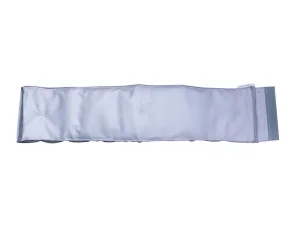





Procurement Benchmark: Technical Sourcing Audit Guide
When evaluating Cast Nozzle Heater exporters, international purchasing departments must verify technical specs beyond basic dimensions and voltage ratings to guarantee line uptime.
1. Bore Surface Machining Tolerance
Require supplier verification of CNC internal boring. Smooth surface finishes ($Ra < 1.6\,\mu\text{m}$) maximize intimate metal-to-metal contact with the machine nozzle, ensuring rapid dissipation of heat and preventing hot spots.
2. Terminal Lead Protection Options
Nozzle areas are prone to physical strain and polymer drool. Ensure your factory specification specifies armor cable, stainless steel braid, or 90-degree heavy-duty block terminals with silicone sealing sleeves.
3. Clamp Mechanism Design
Cast nozzle heaters rely on robust clamping (such as internal hex socket screws or low-profile tangential clamping blocks) to maintain high contact pressure even under thermal expansion cycles.
Frequently Asked Questions (Technical & Procurement FAQ)
Detailed technical insights answering key engineering queries regarding custom cast nozzle heaters, manufacturing lead times, warranty terms, and operational practices.
Q1: What is the main advantage of a Cast Nozzle Heater over a traditional Mica Band Heater?
Cast Nozzle Heaters feature a solid metal matrix (aluminum or bronze) encapsulating the heating element. This construction renders the heater completely sealed against liquid plastic blow-back or drool, which frequently short-circuits standard mica heaters. Furthermore, cast bronze heaters tolerate far higher operating temperatures (up to $650^\circ\text{C}$) and higher watt densities.
Q2: When should I specify Cast Bronze/Copper instead of Cast Aluminum for my nozzles?
Cast Aluminum is optimal for process temperatures up to $350^\circ\text{C}$ and standard resins (PE, PP, PS, ABS). Cast Bronze or Copper is mandatory when processing high-temperature engineering polymers (PEEK, PPS, PTFE, PA66 with high filler content) requiring nozzle temperatures between $350^\circ\text{C}$ and $650^\circ\text{C}$, or where high mechanical clamping forces could deform soft aluminum castings.
Q3: How does Kangpu Heater guarantee non-porous metal castings?
We employ precision permanent-mold gravity die casting combined with controlled alloy degassing techniques. Each batch of casting undergoes metallurgical density validation and X-ray void inspection to guarantee zero air pockets around the internal heater element coil.
Q4: Can cast nozzle heaters be customized with built-in thermocouple holes or cutouts?
Yes. We custom-engineer every unit to your technical drawing or physical sample. We can cast or CNC-machine internal thermocouple grooves (for J-type or K-type sensors), custom mounting flat spots, flame-cut clearance slots, and non-standard lead exit angles.
Q5: What after-sales warranty terms does Kangpu provide for OEM buyers?
We back our industrial electric heating products with a full 5-year warranty. Every product batch is digitally indexed with full component traceability (resistance wire heat number, MgO insulation batch, casting alloy certificate) to ensure long-term reliability.
Q6: What is the typical lead time for custom sample approval and mass production?
Following CAD drawing confirmation, sample production using real production molds takes 7–10 days. Once sample testing is confirmed by the customer, full mass production orders are completed within 15–21 calendar days depending on order volume.
Q7: How do I prevent premature heater failure caused by poor mechanical fit?
Ensure the machine nozzle surface is thoroughly cleaned of carbonized plastic scale before installation. Torque the clamping bolts evenly to ensure full circumference contact. After initial heat-up to operating temperature, retighten clamping bolts to account for initial thermal expansion differentials.