Primary Catalog
High-Efficiency Industrial Heating Systems & Components
Engineered for high thermal transfer, extreme operational stability, and rapid thermal cycling across global continuous process environments.





98.2%
Thermal Conversion Efficiency
30-50%
Net Energy Reduction
< 0.5s
Electromagnetic Response
100+
Export Destinations
Strategic Architecture
Electromagnetic Induction Heating: The Industrial Paradigm Shift
A comprehensive engineering transition from resistive thermal conduction to non-contact electromagnetic eddy-current induction.
Direct Excitation Dynamics
Traditional resistive heating bands operate via conduction, transferring heat through mechanical contact interfaces where surface resistance creates up to 40% thermal dissipation. Electromagnetic induction heaters generate high-frequency magnetic flux penetrating the barrel or vessel directly, exciting internal molecular currents to produce uniform heat intrinsically within the metal itself.
Thermal Decoupling & Ambient Safety
By encasing induction coils within advanced aerospace-grade aerogel insulation, the exterior surface remains cold to the touch (typically under 50°C even during 450°C operations). This eliminates catastrophic ambient radiant losses, radically slashes factory air-conditioning HVAC loads, and dramatically mitigates occupational burn hazards for shop-floor personnel.
Sub-Second Closed-Loop Response
Eliminating the thermal mass and thermal inertia inherent to cast-in aluminum or ceramic blocks enables instantaneous ramp-up and drop-down control. Coupled with digital DSP microcontroller modules and PID algorithms, induction heating achieves precision barrel thermal boundaries of ±1°C, vital for tight-tolerance extrusion of sensitive polymers.
Global Sourcing Analysis
International Procurement Requirements & Decarbonization Mandates
Meeting Scope 1 and Scope 2 emission standards while navigating strict operational margins across heavy industrial manufacturing corridors.
European Union: CBAM Compliance
With the phase-in of the Carbon Border Adjustment Mechanism (CBAM) and tightening ISO 50001 energy auditing protocols, Tier-1 European processors are actively phasing out fossil-fuel and low-efficiency resistance heating. Global buyers prioritize electromagnetic induction systems backed by verified lifecycle analysis (LCA), CE electrical safety, and low specific energy consumption (SEC).
North America: Heavy Duty Extrusion
In the US and Canada, aging infrastructure demands replacement solutions with high power densities, NEMA-compliant enclosures, and UL/CSA electrical design architecture. Procurement focuses on retrofittable induction coils capable of withstanding intense 24/7 continuous pipe extrusion, blown film, and compounding lines where unplanned maintenance downtime costs thousands of dollars per hour.
Emerging Markets: Scalability & ROI
Across Southeast Asia, the Middle East, and Latin America, manufacturing hubs are transitioning from labor-intensive setups to automated plastics and petrochemical processing lines. Buyers target OEM and turnkey exporters offering plug-and-play modular induction control units, comprehensive wiring schematics, and an investment payback cycle strictly within 6 to 14 operational months.
Manufacturing Capabilities
China Factory 4.0: Supply Chain Resilience & Customization Velocity
Combining four decades of specialized heating domain expertise with vertically integrated smart manufacturing in Yancheng, Jiangsu.
Solid-State IGBT Inverter Design
Our manufacturing cluster leverages sixth-generation insulated-gate bipolar transistor (IGBT) modules, smart resonance frequency tracking (10 kHz - 40 kHz), and adaptive phase-locked loop (PLL) control to maintain peak resonance under dynamic metal permeability conditions.
End-to-End Quality Verification
From automated wire-winding robots ensuring zero inductance drift to pressurized insulation dielectric breakdown tests exceeding 2500V, every induction coil assembly passes rigorous 72-hour burn-in protocols before export clearance.
Direct-to-Drawing Customization
We eliminate trading intermediaries. Factory engineers interface directly with client CAD designs, configuring custom coil configurations, thermocouple wells, integrated fan-forced cooling blowers, and specialized terminal junctions tailored to your exact machinery footprint.
Supply Chain Redundancy
Located in the heart of China’s advanced electrical equipment corridor, our factories maintain extensive buffer reserves of oxygen-free copper litz wire, high-temperature mica sheeting, and premium ferrite magnetic flux concentrators to insulate clients from global raw-material bottlenecks.
Engineering Benchmark
Comparative Thermal Performance Matrix
Detailed technical assessment: Electromagnetic Induction Heating vs. Legacy Resistance Systems.
| Evaluation Parameter | Electromagnetic Induction Heater | Cast-in Aluminum Heater | Ceramic Band Heater | Mica Band Heater |
|---|---|---|---|---|
| Thermal Efficiency | 93% - 98% | 65% - 75% | 60% - 70% | 50% - 60% |
| Preheat Velocity (to 300°C) | 8 - 15 minutes | 35 - 55 minutes | 30 - 45 minutes | 25 - 40 minutes |
| External Shell Temperature | 40°C - 55°C (Safe touch) | 250°C - 320°C (High hazard) | 180°C - 260°C (High hazard) | 160°C - 240°C (High hazard) |
| Thermal Response Latency | Instantaneous (<0.5 sec) | High (Massive thermal inertia) | Moderate (Ceramic lag) | Fast (Low thermal mass) |
| Heating Element Lifespan | > 50,000 Hours (Non-contact) | 15,000 - 25,000 Hours | 10,000 - 18,000 Hours | 6,000 - 12,000 Hours |
| Energy Reduction Potential | 30% - 50% vs Resistance | Baseline benchmark | 5% - 10% saving vs Mica | High consumption |
Use Case Deployments
Localized Heavy Industrial Application Scenarios
Field-proven deployments of electromagnetic induction systems across diverse industrial process conditions.
High-Output Plastic Extrusion & Blow Molding
For twin-screw pelletizing, masterbatch compounding, and high-density polyethylene (HDPE) corrugated pipe lines, induction heaters eliminate melt quality variation. Precise barrel zone control eliminates resin degradation and scorching, allowing lines to increase screw RPM and boost overall hourly output by up to 18%.
Industrial Pipeline & Viscous Fluid Transport
In midstream crude oil networks, asphalt transfer installations, and chemical processing facilities, electromagnetic pipeline heaters provide uniform, non-contact heating. Without internal flow-impeding immersion heaters, fluid flows without shearing, coking, or localized hotspots, slashing pumping energy overhead.
Clean Steam Generation & Thermal Boilers
Electromagnetic steam boilers convert treated water into saturated steam rapidly without fossil fuels or open combustion. This serves food processing plants, pharmaceutical cleanrooms, and chemical sterilization autoclaves seeking zero-emission certification and zero boiler chimney heat exhaust losses.
Technical Inquiry
Engineering Questions & Procurement FAQ
Comprehensive answers addressing electromagnetic compatibility, retrofitting complexity, coil sizing, and lifespan expectations.
How does electromagnetic induction heating achieve a 30% to 50% energy reduction?
Traditional electric heating bands rely on thermal conduction: electricity heats an internal resistance wire (nickel-chromium), which transfers heat to an insulator (mica or ceramic), then through a metal jacket, and finally through the physical contact surface into the barrel. This chained conduction involves severe boundary layer losses, with up to 45% of generated heat radiating out into the room. Electromagnetic induction bypasses thermal contact completely. An alternating high-frequency magnetic field penetrates directly into the metal barrel wall, producing localized eddy currents that make the steel self-heat. With high-efficiency thermal insulation wrapped directly underneath the induction coil, heat radiation to the surrounding plant is nearly zero.
Can existing extruder or injection machinery barrels be retrofitted with induction coils?
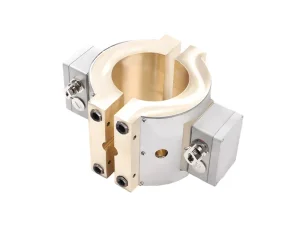
Yes. Retrofitting does not require modifying screws, drives, or existing machine control architectures. Our custom modular electromagnetic heater shells are designed in split cylindrical halves that match the identical outer dimensions, width constraints, and thermocouple locations of your legacy cast-in or ceramic heaters. Our control units interface cleanly with your existing PLC temperature output cards (accepting standard 4-20mA, 0-10V, or 24V SSR pulses).
What maintenance is required for electromagnetic induction heaters?
Because induction coils do not heat up themselves and do not operate under mechanical or thermal expansion stress, their theoretical operating life exceeds 50,000 hours—far surpassing resistance heating wires that oxidize and burn out over time. Regular maintenance is limited to periodic blowing out of dust from the controller cooling fan intakes and annual inspection of cable tightening torques.
Does high-frequency electromagnetic heating interfere with workshop electronics or sensors?
No. Industrial-grade induction controllers operate between 10 kHz and 40 kHz, enclosed within grounded metal cabinets and shielded with high-permeability ferrite cores that concentrate the magnetic field strictly inside the metal barrel. Our complete units comply with EN 61000-6-2 (Industrial Immunity) and EN 61000-6-4 (Emission Standards), ensuring zero electromagnetic interference (EMI) with nearby PLC racks, servo drives, digital weighing scales, or wireless sensors.
What are the typical lead times, warranty periods, and export inspection steps?
Standard custom-engineered samples are designed, molded, and tested within 7 to 10 working days; batch container orders ship within 18 to 25 days from our Yancheng facility. Kangpu heater solutions include our comprehensive five-year after-sales warranty supported by serialized batch tracking. Prior to dispatch, each product undergoes high-voltage insulation tests, inductance spectrum validation, and real-load thermal cycle verification.
Advanced Solutions
Specialized Industrial Thermal & Ceramic Heaters
Engineered for high-temperature resilience, harsh continuous environments, and precision thermal processing across global manufacturing sectors.