

Featured Catalog
Precision Pipe & Barrel Heating Systems
High-efficiency thermal units manufactured to exact OEM engineering tolerances. Built for maximum heat transfer, minimal watt density drop, and reliable 24/7 uptime.
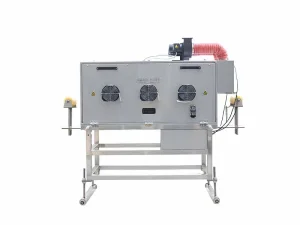
Industrial Intelligence
Global Market Status & Industrial Landscape
A rigorous examination of fluid dynamics, thermal transfer physics, and high-performance pipeline infrastructures across international energy and manufacturing corridors.
Global Infrastructure Resilience
Modern process engineering demands extreme reliability under volatile operating parameters. From cold-weather hydrocarbon transit in North America and Northern Europe to cross-desert petrochemical pipelines in the Middle East, pipeline heaters serve as critical fail-safe hardware. They preserve viscous fluidity, counteract catastrophic paraffin crystallization, and maintain exact Reynolds flow numbers across thousands of uninterrupted operational hours.
The Decarbonization Mandate
Industrial heating historically consumed vast volumes of fossil fuels via fired heaters and heavy oil steam boilers. Global net-zero initiatives are prompting plants to replace direct-combustion solutions with high-density electric pipe heaters and electromagnetic induction boilers. These zero-emission electric architectures offer thermal efficiencies exceeding 96%, converting electrical grid energy directly into fluid kinetics with micro-degree precision.
Rigid Regulatory Frameworks
Exporting pipe heating equipment across international territories requires uncompromised compliance with multi-jurisdictional standards. Our production protocols conform to EU CE directives, ASME Section VIII Boiler and Pressure Vessel codes, and ATEX/IECEx hazardous environment certifications. This ensures our heating systems function reliably in Class I, Division 2 combustible atmospheres without spark generation or outer-wall thermal runaway.
Engineering Authority
40 Years of Thermal Metallurgy & Process Control
Operating as Yancheng Laier Heating Technology Co., Ltd. (Kangpu Heater), our specialized R&D facility engineers heavy-duty electric heating assemblies directly tailored to client flow rates, chemical compositions, and barrel geometries.
In-House Metallurgy & Sheathing
Our pipe elements utilize high-purity crystalline Magnesium Oxide (MgO) compacted to theoretical density limits, combined with precision Nickel-Chromium (NiCr 80/20) resistance alloys. Outer sheaths range from Incoloy 800/840 to 316L/321 stainless steel, providing structural and chemical integrity against hot sulfurous, alkaline, and acidic pipeline fluids.
Computational CFD & Heat Profiling
Thermal uniformity along barrel and pipe geometries is calculated using finite element analysis (FEA) and computational fluid dynamics (CFD). We evaluate baffle configurations, convective boundary films, and localized heat transfer coefficients to eliminate hot spots, suppress boundary-layer coking, and maintain fluid stability.
Strict Quality Governance
Every batch undergoes 100% dielectric strength testing, insulation resistance validation up to 1000V DC, helium mass spectrometer leak detection for pressure housings, and radiography verification of core weldments. Every heater shipped from Yancheng carries fully traceable materials certification to heat numbers.
Application Engineering
Macro-Industrial Solutions & Local Scenarios
Tailored pipe heating solutions operating across demanding industrial manufacturing and bulk distribution environments.
Polymer Extrusion & PVC-O Piping
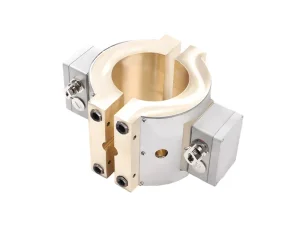
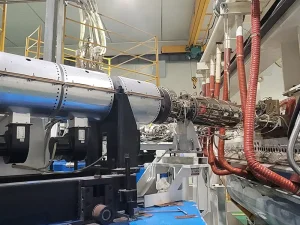
Biaxial molecular orientation in PVC-O pipe manufacturing requires tight thermal gradients across extended barrel runs. Our patented integrated heating/cooling jackets maintain precise melt viscosity without localized thermal overshoot. Cast aluminum/copper heating bands provide uniform thermal conduction, ensuring mechanical burst performance in civil water supply networks.
Petrochemical & Asphalt Handling
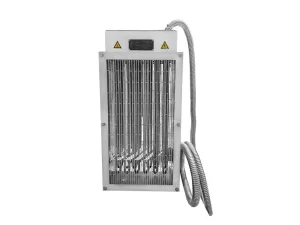
Heavy crude bitumen, refined waxes, and high-melting-point aromatic polymers solidify rapidly if temperatures dip below pumping thresholds. Flanged immersion circulation pipe heaters, rated for working pressures exceeding 150 bar, inject thermal energy directly into the fluid stream. These units sustain consistent pipeline flow velocities and protect multi-stage distribution pumps from mechanical overload.
Sanitary Chemical & Food Systems
High-purity chemical processing and food manufacturing lines require crevice-free, electro-polished stainless pipeline heating assemblies. Kangpu's seamless heating tubes protect sensitive emulsions and pharmaceuticals from degradation, delivering balanced thermal transfers during pasteurization, aseptic transfer, and inline viscosity adjustment.
Future Roadmap
Technological Trajectory & Next-Gen Heating
Continuous investment in cutting-edge materials and IoT connectivity to lead global industry standards.
Smart IoT Thermal Arrays & Predictive Maintenance
Modern pipe heaters are moving beyond static thermostatic loops. Kangpu integrates multi-point RTD thermal sensors and RS-485 Modbus telemetry into heater terminal housings. These systems detect dielectric wear, measure element resistance trends, and alert operators to potential faults before unexpected downtime occurs.
Nano-Infrared Radiation & High-Emissivity Coatings
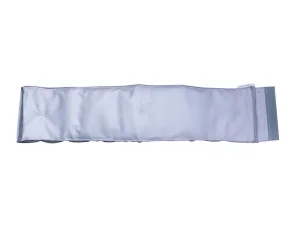
By coating outer heating elements with refractory ceramic metal oxides and employing vacuum aerogel insulation blankets, radiation losses are lowered significantly. External surface temperatures stay below 50°C even while inner pipe lines operate above 400°C, lowering electrical consumption by up to 35%.
High-Frequency Electromagnetic Induction for Superheated Fluids
Direct induction pipe heating transfers energy directly into the metallic pipe wall, achieving instantaneous thermal ramp rates without sheath fatigue. This enables clean, fossil-free production for high-pressure hydrogen, steam, and supercritical chemical processes.
Product Range
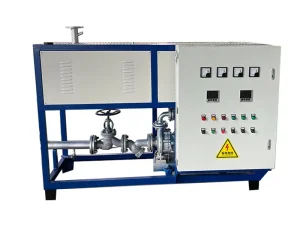
Engineered Process Heating Equipment
Industrial thermal hardware tested for continuous production duty and certified to international standards.




Technical Inquiries
Frequently Asked Questions for Engineers & Buyers
Key technical and procurement criteria when selecting pipe heating systems for heavy industrial service.
How is optimal watt density calculated for circulation pipe heaters?
Watt density (W/cm² or W/in²) depends on the thermodynamic properties of the fluid, its velocity over element sheaths, and maximum film temperature allowances. For light hydraulic oils or water circulation, densities of 5–8 W/cm² are typical. For viscous crude bitumen, lube oils, or sensitive polymers, watt density must be reduced to 1.2–2.5 W/cm² to prevent boundary-layer coking and sheath oxidation.
Can Kangpu manufacture pipeline heaters to custom engineered drawings?
Yes. Direct customization represents our core production strength. Clients supply pressure vessel data, barrel dimensions, electrical specifications, and media chemistries. Our engineering division manages the complete validation lifecycle: ID design, real-mold development, electrical and hydrostatic validation, and final series production backed by our comprehensive 5-year warranty.
When should cast aluminum or cast copper heaters be specified over standard ceramic bands?
Ceramic band heaters offer cost-effective radiant performance up to 500°C–600°C on extruder barrels. However, when working with high-pressure pipelines or continuous extrusion requiring integrated liquid cooling channels, cast aluminum (up to 400°C) or cast copper/bronze (up to 700°C) provides superior thermal conductivity and mechanical clamping durability.
What certifications and safety protocols govern your export shipments?
All heating systems shipped across international corridors conform to CE machinery and low-voltage directives. Equipment intended for hazardous classified zones can be specified with explosion-proof terminal enclosures (IP66/NEMA 7/ATEX/IECEx ratings). Every shipment includes complete factory acceptance test (FAT) documentation, insulation testing, and heat-number metallurgy traceability.
How do nano-infrared heating retrofits improve pipeline efficiency?
Traditional ceramic or mica bands transfer substantial heat outward into the facility environment. Nano-infrared bands focus radiant energy directly into the pipe wall while integrating an aerogel insulation jacket, resulting in outer wall temperatures below 50°C and reducing facility electrical draw by 25% to 35%.