
High-Efficiency Industrial Heating Systems
Explore our certified, precision-machined pipeline and industrial heating elements designed to operate consistently under extreme process parameters.

CE Certification Cast Aluminum/Copper Heater Manufacturer, Exporter
View Details
High-Quality Cleaning Furnace Manufacturer, Exporter
View Details
CE Certification Explosion Proof Electric Heater Exporter, Factory
View Details
Best Efficient Portable Ceramic Heaters Ideal for Industrial Heating
View Details
China Efficient Portable Ceramic Heaters for Industry
View Details
CE Certification PVC-O Ovens for Precision Heating Manufacturer
View Details
China High Density Heating Element Manufacturers, Factories
View Details
Reliable Portable Ceramic Heating Solutions from China Suppliers
View DetailsThe Paradigm Shift in Modern Pipeline Heating Engineering
Decarbonization, computational fluid dynamics (CFD), and modular process electrification are transforming how global industries implement thermal control.
Process Electrification & Zero Direct Emissions
Global refineries and chemical plants are systematically phasing out open-flame fuel gas reboilers in favor of flanged circulation heaters. Electric pipeline heaters provide nearly 100% thermal conversion efficiency at the point of application, eliminating localized greenhouse gas emissions and simplifying permitting procedures under stringent carbon frameworks like the EU ETS and ISO 50001.
Optimization of High Watt-Density Transfer
Contemporary pipelines transporting high-viscosity fluids (e.g., bitumen, heavy crudes, biological fats) require tight boundary layer control. Through modern CFD modeling, internal baffles are placed strategically to eliminate fluid stagnation and dead zones, avoiding thermal coking and premature element degradation while maximizing heat transfer rates.
Smart Predictive Thermal Asset Management
By embedding redundant multi-point Type K/N thermocouples directly inside heating element sheaths combined with continuous insulation resistance (IR) monitoring, heating vessels can feed real-time performance telemetry back into plant distributed control systems (DCS). This proactive paradigm ensures predictive maintenance before sheath breaches disrupt fluid flow.
Engineered for Zero Downtime in Critical Infrastructure
Operating from our modern facility in Yancheng, Kangpu Heating (Yancheng Laier Heating Technology) combines four decades of metallurgical mastery with rigorous quality benchmarks.
Explosion-Proof Mechanical Integrity
Our pipeline immersion and circulation assemblies are packaged in ATEX, IECEx, and CE-certified terminal enclosures (Ex d / Ex e ratings). Designed to handle hazardous Zone 1/2 environments, terminal boxes feature integrated condensation protection and nitrogen purging ports for offshore environments.
Advanced Metallurgy Sheath Selection
Elements are drawn using seamless tubular geometries formed with Incoloy 800/840, Stainless Steel 316L, 321, or Hastelloy. Compaction with high-purity electro-fused magnesium oxide (MgO) achieves maximum dielectric resistance and rapid thermal conduction away from internal resistance ribbons.
ASME & PED Code Pressure Vessels
Chamber housings are manufactured in full compliance with ASME Section VIII Division 1 and European Pressure Equipment Directive (PED 2014/68/EU). Every unit undergoes non-destructive evaluation (NDE), dye penetrant inspections, and 1.5x hydrostatic pressure proof tests prior to dispatch.
Macro-Industry Solutions & Fluid Applications
Custom pipeline thermal platforms built to eliminate pressure drops, avoid crystallization, and maintain strict process rheology across diverse sectors.
Petrochemical & Hydrocarbon Refinement
Critical in fuel oil preheating, catalyst re-activation lines, natural gas dew point maintenance, and asphalt storage systems. Balanced watt-density designs minimize localized boundary thermal degradation while handling high inlet velocities.
Polymer Processing & Extrusion Die Loops
Integrated pipeline heaters deliver steady temperatures to polymer transport lines, melt pumps, and resin manifolds. Coupled with our cast aluminum/copper technologies, lines maintain precise viscosities from extruder barrel to exit dies.
Sanitary Food & Pharmaceutical Circulation
Designed with electropolished 316L wetted surfaces and crevice-free internal baffles to support Clean-In-Place (CIP) and Steam-In-Place (SIP) routines. Prevents product fouling during the heating of edible oils, syrups, and pharmaceutical bases.
Pipeline Thermal Selection & Parameter Matrix
A reference guide to optimize physical dimensions, watt density, and material selections according to target media dynamics.
| Target Fluid / Gas Media | Recommended Sheath Material | Typical Watt Density Range | Design Temperature | Common Process Hazards |
|---|---|---|---|---|
| Clean Water & Aqueous Solutions | AISI 304 / Incoloy 800 | 8.0 – 12.0 W/cm² (50 – 75 W/in²) | Up to 100°C (212°F) | Limescale, galvanic corrosion |
| Thermal Heat Transfer Oils | AISI 321 / Incoloy 840 | 1.5 – 3.0 W/cm² (10 – 20 W/in²) | Up to 350°C (662°F) | Thermal fluid cracking, carbon coking |
| Heavy Fuel Oil / Crude / Bitumen | AISI 316L / Incoloy 800 | 1.0 – 1.8 W/cm² (6 – 12 W/in²) | Up to 260°C (500°F) | Tar buildup, extreme viscosity drops |
| Forced Air & Gaseous Nitrogen | AISI 304 / Incoloy 840 | 3.0 – 5.0 W/cm² (20 – 32 W/in²) | Up to 600°C (1112°F) | Rapid element overheating if flow drops |
| Corrosive Acid / Chemical Streams | Hastelloy C-276 / Incoloy 825 | 1.0 – 2.5 W/cm² (6 – 16 W/in²) | Site Dependent | Pitting corrosion, stress cracking |
Next-Generation Pipeline Heating Systems
Continuous investment in thermal material science and power electronics is reshaping our manufacturing horizon.
Silicon Carbide (SiC) Power Controllers
Moving beyond standard triac-based SCR units, our research centers on deploying solid-state SiC matrix switches to deliver clean, stepless power modulation, maintaining thermal balance within +/- 0.5°C while eliminating high-frequency harmonic feedback into enterprise power grids.
Advanced Ceramic & Nanocoatings
Integrating chemical vapor deposited (CVD) ceramic diffusion layers across the outer sheath walls to prevent hydrogen embrittlement and scale aggregation when heating high-sulfur hydrocarbons or aggressive saline process streams.
Integrated Digital Twin Diagnostics
Engineering factory-calibrated physics simulation software into deliverable control panels. Operators can cross-examine real-time flow rate, inlet temperature, and power consumption against the factory benchmark digital twin to identify internal fouling.
Frequently Asked Questions
Essential guidance for engineering, procurement, and maintenance teams evaluating custom industrial heaters.
How do you determine the correct watt density for a pipeline heater?
Watt density (W/cm² or W/in²) is directly dictated by the thermal conductibility, specific heat, viscosity, and flow velocity of the heated medium. Viscous fluids like asphalt or heavy oil require conservative watt densities (1.0 to 1.8 W/cm²) to avoid thermal decomposition (coking) and sheath burning. Clean recirculating water or compressed air can tolerate higher watt densities (up to 8 to 12 W/cm²). Our engineers conduct CFD modeling to verify safe operating skin temperatures.
Can Kangpu design and produce custom heaters based on engineering drawings?
Yes. Custom engineering accounts for over 85% of our production volume. Clients provide process specs, flow rates, inlet/outlet temperatures, operating pressures, and space limitations. Our design workflow spans seven verified stages: ID concept modeling, custom component detailing, production-grade real mold fabrication, customer sample confirmation, iterative refinement, full mechanical/dielectric testing, and final mass production.
What specific after-sales warranty and trace mechanisms do you provide?
Kangpu provides a dedicated five-year warranty covering manufacturing and material defects. Every unit manufactured carries an indelible laser-engraved serial plate corresponding to an internal quality certificate. Raw material traceability, welder logs, non-destructive test records, and megohm insulation resistance certificates are retained for full life-cycle accountability.
What safety features prevent catastrophic burnout during sudden fluid flow stalls?
Our pipeline heaters feature three layers of safety protection: internal element skin thermocouples monitoring direct sheath temperature, external process outlet limit sensors, and differential pressure interlocks wired directly to the main power contactor or shunt trip. If process flow drops below minimum design velocity, the control circuit cuts power to prevent element overheating.
How do pipeline heaters compare with heat tracing cables for flow lines?
Heat tracing cables compensate for ambient transmission losses across long pipe runs, maintaining already heated fluids. In contrast, pipeline heaters are active high-energy thermal devices engineered to increase fluid temperature inline during active pumping. They are suited for core process stages, start-up preheating, and maintaining critical high-velocity flow lines.
Engineered Elements & Replacement Components
Explore our complete product line, including coil heaters, mica systems, flexible heaters, and industrial ventilation accessories.
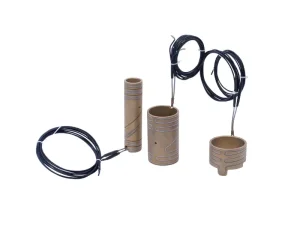
High-Quality Hot Runner Spring Heater/Coil Heater Manufacturers
View Details
China Safe and Durable Industrial Mica Heaters Factory
View Details
China Portable Ceramic Heaters for Industry Exporter
View Details
High-Quality Ceramic Solutions from China Suppliers
View Details
CE Certification Flexible Heaters for Custom Applications
View Details
Best Durable Heat Insulation Covers Manufacturer, Exporters
View Details
CE Certification Fan Manufacturer, Factory
View Details