
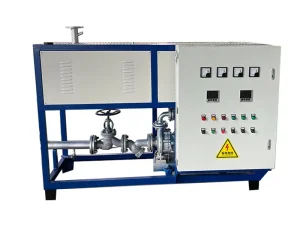
Nagoya Grade High-Quality Heat-Conducting Oil Furnace
Designed for high-temperature closed-loop circulation up to 350°C with low operating pressure and uniform flux distribution.
Direct factory export configurations engineered for high thermal stability, minimal viscosity degradation, and micro-tolerance temperature control in continuous manufacturing cycles.
Designed for high-temperature closed-loop circulation up to 350°C with low operating pressure and uniform flux distribution.

Automated thermal burnout and vacuum decomposition furnace engineered for spinnerets, melt-blown dies, and extruder screws.

Instantaneous induction evaporation delivering dry industrial steam within 60 seconds with no localized flue-gas footprint.

Custom-tailored thermal barriers reducing external barrel skin temperatures to below 45°C while mitigating ambient factory heat loads.
Why the Greater Nagoya region (Chukyo Industrial Area) demands next-generation thermal fluid oil furnaces and uncompromising process control.
Nagoya, positioned at the core of Aichi Prefecture, represents Japan’s unchallenged industrial titan. Responsible for leading the nation in manufactured goods shipment value for over four consecutive decades, the Chukyo Industrial Zone houses the absolute global benchmark for automotive engineering (Toyota Motor Corporation and its comprehensive Tier-1 keiretsu including Denso, Aisin, and Toyota Industries), aerospace production (Mitsubishi Heavy Industries, Subaru Aerospace), and advanced synthetic materials engineering.
Within this exacting ecosystem, thermal process consistency is not an operational variable—it is a determinative determinant of structural yield and metrological conformity. Industrial oil furnaces (heat-conducting oil heating systems / organic heat transfer fluid heaters) provide the critical thermal foundation across an expansive matrix of high-stress regional applications:
Engineering Assessment: Conventional steam boilers operate at elevated saturation pressures (exceeding 1.5–2.5 MPa at 200°C), introducing catastrophic explosion risks, severe boiler-pipe wall erosion, and continuous water chemical treatment overhead. Modern heat-conducting oil furnaces achieve process temperatures up to 350°C under hydrostatic operating pressures beneath 0.4 MPa, slashing pressure-vessel risk profiles while improving thermodynamic transfer efficiency by up to 28%.
The Japanese Ministry of Economy, Trade and Industry (METI) together with the Green Growth Strategy Through Achieving Carbon Neutrality in 2050 has imposed rigorous energy-efficiency covenants on regional industrial operations in Aichi, Mie, and Gifu prefectures. Facilities operating legacy heavy-oil fired combustion boilers are aggressively transitioning to closed-circuit, low-NOx gas or electrically driven electromagnetic heat-conducting oil systems.
Kangpu Heater / Yancheng Laier addresses this transformational imperative by engineering export-grade thermal fluid furnaces that merge high watt-density precision elements with multi-pass serpentine tube exchangers, ensuring comprehensive compliance with JIS B 8201 (Boilers - Construction), the High Pressure Gas Safety Act, and the Industrial Safety and Health Act of Japan.
Bridging China's mature industrial manufacturing belt with Japan's uncompromising quality tolerances through deep vertical integration.
Operating from our 40-year industrial foundation in Yancheng, Jiangsu, we execute full cold-drawn seamless carbon steel (GB/T 3087, ASTM A106, or JIS G3454) and SUS304/SUS316 tube bending, ultrasonic flaw detection, and automatic submerged-arc welding in a single, strictly controlled facility.
Thermal cracking and coking of synthetic heat-transfer oils (such as Therminol, Dowtherm, or Marlotherm) represent the primary failure modes in industrial furnaces. Our systems feature engineered watt densities below 2.2 W/cm² to ensure film temperatures remain safely below thermal degradation limits.
For chemical and solvent extraction lines in Nagoya’s coastal industrial zones (Nagoya Port, Yokkaichi, and Tokai), we supply certified explosion-proof junction boxes (Ex d IIB/IIC T1-T4) configured with hermetic gas-barrier seals, dual thermal cutouts, and redundant ground fault isolation.
| Performance Dimension | Kangpu Export-Grade Oil Furnaces | Conventional Gas/Oil Burners | Traditional High-Pressure Steam |
|---|---|---|---|
| Maximum Working Temp | 350°C (Thermal Oil) | 250°C - 300°C | 180°C - 210°C (Saturated) |
| System Operational Pressure | 0.2 - 0.45 MPa (Hydrostatic) | Atmospheric to 0.2 MPa | 1.6 - 3.2 MPa (Extreme Risk) |
| Thermal Regulating Precision | ±0.5°C (PID Cascade SCR) | ±3.0°C to ±5.0°C | ±2.5°C (Pressure dependent) |
| Maintenance & Piping Corrosion | Zero scaling; Non-corrosive fluid closed loop | Soot cleaning, Burner tip maintenance | Severe chemical dosing, de-aeration, blowdown |
| Local Compliance (Japan) | JIS Standard Compatible; CE / METI guidelines | Stringent exhaust gas NOx/SOx caps | Mandatory licensed Boiler Operator on site |
A systematic methodology engineered to eliminate supply chain friction, deliver clear documentation, and satisfy rigorous factory acceptance testing.
Global procurement teams serving Japanese clients operate under zero-defect expectations. When importing heavy industrial capital equipment into the Port of Nagoya, delivery non-conformance can cause multi-week plant commissioning halts. Kangpu enforces an uncompromising 7-phase quality gateway for all export-bound oil furnaces:
Shipments dispatched to the Port of Nagoya (one of Japan’s premier logistics gateways handling over 200 million tons annually) are secured with IPPC-certified fumigated ISPM-15 wooden cases, multi-layer vapor corrosion inhibitor (VCI) film enclosures, and desiccated silica gel barriers to defend against maritime humidity and saline air intrusion.
Full export dossiers accompany every bill of lading: Mill Test Certificates (EN 10204 Type 3.1), Welding Procedure Specifications (WPS), Procedure Qualification Records (PQR), Electrical Schematics in bilingual Japanese/English format, and spare parts interchangeability catalogs.
Discover how Kangpu's thermal oil heating solutions deliver operational reliability across diverse manufacturing environments.
High-pressure die-casting tools require rapid preheating to 200°C–250°C before the first molten aluminum shot to prevent chilling and cold shuts. Kangpu oil furnaces utilize high-flow centrifugal canned motor pumps to maintain turbulent fluid flow through internal die micro-cooling/heating circuits, guaranteeing thermal equilibrium across complex cavity profiles.
For carbon fiber wings, fairings, and structural panels, Kangpu oil furnaces integrate multi-stage ramp/soak profiles. Cascade thermal oil loops heat multi-platen hot presses with spatial temperature uniformity across 3m x 6m surfaces held within ±1.5°C, eliminating void formation and incomplete resin polymerization.
Viscous chemical synthesizers, jacketed reactors, and polymer melt lines demand continuous high-temperature heat transfer without localized boundary-layer overheating. Our systems incorporate dual expansion vessels and automatic nitrogen blanketing to prevent thermal oil oxidation and maintain pristine optical resin clarity.
In-depth answers addressing thermal calculations, fluid life expectancy, Japanese regulatory clearance, and long-term operating economics.
Thermal oil coking occurs when the fluid boundary layer film temperature exceeds the maximum bulk temperature threshold specified by fluid manufacturers. Kangpu mitigates this via three core design elements:
In Japan, equipment operating above commercial thresholds must align with the Electrical Appliance and Material Safety Act (PSE compliance where applicable for specific consumer components), METI Technical Standards for Electrical Equipment, and the Industrial Safety and Health Law. For oil furnaces, if rated under specific volume and pressure parameters, they avoid the stringent full statutory inspections mandated for primary high-pressure steam boilers.
Our electrical panels feature CE-certified, UL-recognized, and JIS-standard components (Schneider, Fuji Electric, Mitsubishi Electric, and Omron contactors/breakers) configured to standard Japanese plant voltages: 200V 3-Phase, 220V 3-Phase, or 400V/440V 3-Phase at 50Hz (Eastern Japan) or 60Hz (Nagoya / Western Japan).
Yes. Space optimization is a hallmark of Japanese plant layout engineering. Our 7-stage custom manufacturing process includes comprehensive 3D CAD modeling (STEP / IGES files provided for pre-shipment collision detection in your factory simulation software). We specialize in compact skid-mounted configurations, vertical cylindrical heater vessels, and integrated multi-zone heating/cooling units that house circulation pumps, expansion tanks, and heat exchangers within a single compact footprint.
Kangpu offers an industry-leading five-year after-sales warranty on core heating structural weldments and pressure boundaries, supported by complete batch traceability down to the raw tube heat number and batch test certificates. In the event of a replacement requirement, we maintain modular spare element assemblies that can be air-freighted via DHL/FedEx directly into Chubu Centrair International Airport (NGO) within 72 hours.
While initial unit electrical energy rates in Japan can be higher than natural gas, electric thermal fluid systems achieve up to 98% point-of-use thermal efficiency compared to 75–82% for gas-fired boilers (due to flue gas stack losses). Furthermore, electric oil furnaces eliminate:
When evaluated over a 10-year operational horizon in Tier-1 automotive mold preheating duty cycles, electric thermal oil systems consistently yield a 15% to 22% lower total lifecycle cost of ownership.
Complete heating element portfolio for extrusion, injection molding, clean steam generation, and hazardous environment deployment.
Combustion-free induction steam generation designed for cleanrooms, sterile processing, and industrial autoclaves.

Flexible ceramic link construction delivering temperatures up to 700°C for barrel and tooling preheating.

Long-wave infrared ceramic radiation panels suited for thermoforming, paint drying, and surface curing.
Engineered with high-grade alumina ceramic cores and nickel-chromium resistance ribbons for durability.
Optimized for industrial plants requiring supplementary zonal heating and accelerated mold changeovers.

Integrated dual-mode thermal zone system that controls melt shear heat overshoot with precision air cooling.

Direct barrel electromagnetic excitation cutting electricity consumption by up to 35% compared to resistance coils.

Heavy flanged immersion heater built for flammable vapor atmospheres, oil refineries, and chemical synthesis.
Consult directly with our Chief Thermal Engineers. From thermal oil balance calculations and ASME/JIS specification reviews to customized sample mold fabrication, we deliver engineered heating systems with factory-direct supply chain velocity.