Convection Heater vs Radiant Heater: The Definitive OEM/ODM Factory Guide
Architectural thermodynamic selection, heavy-duty industrial heating matrices, and precision thermal engineering delivered with 40 years of precision supply-chain resilience.
Featured Precision Thermal Elements
Direct factory-engineered heating systems delivering high energy density, CE/UL standard compliance, and verified performance.





Thermodynamic Mechanics: Convection vs Radiant Heating
Procurement teams and mechanical engineers face fundamental heat transfer decisions. Choosing between natural or forced fluid convection and infrared radiant emission impacts operational thermal dynamics, energy efficiency ratios, and process stability.
Convection Heating Mechanisms
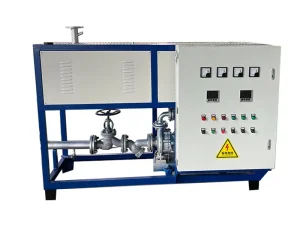
Convection relies on mass fluid movement (Newton’s Law of Cooling: q = h × A × ΔT). In air duct heaters, hot air blowers, and oil furnaces, the heating elements transfer energy to intermediate fluids (air, nitrogen, water, or thermal oils). While this ensures uniform ambient heat envelope dispersion across closed industrial volumes, it introduces thermal inertia lag and boundary layer air resistance.
Radiant (Infrared) Heating Mechanisms
Radiant heating obeys the Stefan-Boltzmann law (E = ε × σ × T⁴), transmitting electromagnetic energy directly to surfaces without heating the intervening air volume. Nano-infrared bands, ceramic plaques, and quartz emitters achieve instantaneous thermal transfer. These systems suit low-conductivity operations, targeted machine zones, and fast-response extrusion barrels.
| Evaluation Parameter | Industrial Convection Heating | Industrial Radiant / Infrared Heating |
|---|---|---|
| Primary Transfer Mode | Bulk Fluid/Gas Convection (Natural or Forced) | Electromagnetic Radiation (0.75 μm - 1000 μm) |
| Thermal Rise Latency | 15 - 45 Minutes (Air volumetric saturation) | 10 - 90 Seconds (Instant surface excitation) |
| Energy Target Efficiency | 65% - 78% (Thermal loss via ambient draft) | 88% - 96% (Direct target absorption) |
| Air Stratification Impact | High (Hot air naturally pools at ceiling limits) | Negligible (Direct directional emission) |
| Optimal Production Usage | Drying tunnels, curing ovens, HVAC ducts | Plastics extrusion, thermoforming, spot curing |
Localized Global Industrial Use-Cases
Deployments adapt to regional environmental and industrial constraints across global markets.
Cold-Climate Northern Europe & DACH
Extremely cold environments demand high-efficiency convection ducting to offset draft-induced wall heat loss in automated processing hubs and plastics recycling facilities.
North American High-Throughput Extrusion
US and Canadian processing lines rely on cast aluminum and ceramic radiant band assemblies to minimize cycle stabilization latency across continuous pipe extrusion.
Southeast Asian High-Humidity Assembly
Sealed, corrosion-resistant convection ovens and radiant drying tunnels prevent moisture absorption during circuit board conformal coating and high-speed packaging.
Middle East Petrochemical & Refining
Hazardous processing plants utilize ATEX-rated explosion-proof thermal fluid convection units to maintain pipeline viscosity under strict surface-temperature controls.
Chinese Supply-Chain Resilience & Kangpu Ecosystem
Headquartered in the Yancheng industrial manufacturing cluster, our supply-chain model provides stable material traceability, automated quality control, and scalable production runtimes.
40+
Years Experience (1986)
100+
Core Technologies
100+
Global Export Markets
5-Yr
Full Traceability Warranty
Raw Material Integration
Direct tier-one sourcing of high-purity Ni80Cr20 resistance wire, Swedish Kanthal filaments, premium muscovite mica, and heat-resistant steatite ceramics preserves thermal output consistency.
7-Stage Sampling Protocol
Every OEM custom development cycle follows dedicated real-mold sampling, dielectric withstand verifications, and operational life-testing before mass production release.
Scale-Driven Unit Economics
Integrated production workflows—from sheet-metal stamping to CNC casting—lower unit procurement costs while meeting strict international tolerance thresholds.
Technology Roadmap: Next-Gen Industrial Thermal Horizons
Decarbonization, smart factories, and stricter safety standards are accelerating three technological shifts across industrial heating systems:
1. IoT-Embedded Edge Diagnostics
Integrated multi-point thermocouples and smart shunt sensors monitor localized resistance drift, signaling preventative maintenance triggers prior to element failure.
2. Hybrid Radiative-Convective Systems
New extrusion systems integrate nano-infrared bands with closed-loop forced air jackets. This design achieves fast start-up ramp rates without risking thermal runaway during shear spikes.
3. Advanced Graphene & Ceramic Matrices
Next-generation radiative coatings and ultra-dense insulation barriers cut exterior casing temperatures below 45°C, improving work-cell safety and reducing factory HVAC loads.
Localized Engineering Support & Compliance Assurance
Kangpu Heater (Yancheng Laier Heating Technology Co., Ltd.) verifies all custom heaters and systems through a systematic international certification framework:
CE Low Voltage & EMC Directive
Full EN 60335 compliance ensures dielectric isolation withstand values exceed 1500V/0.5mA for safe operation on high-voltage industrial grids.
ATEX / IECEx Explosion Safety
Certified terminal enclosures and process pipeline systems meet Zone 1 and Zone 2 containment requirements for combustible volatile environments.
UL 499 & CSA Industrial Norms
Thermal cutoff architectures and custom lead wire terminations meet North American machine integration codes and field inspection standards.
RoHS & REACH Compliance
Heavy metal trace controls and high-temperature lead insulation compounds align with environmental mandates for cross-border logistics.
Engineering Q&A: Factory Selection Insights
How does Kangpu handle custom industrial element tolerances?
We work directly from customer CAD drawings or machine specifications. Our production teams verify inner diameter tolerances within ±0.5mm, match sheath material alloys to the operating atmosphere, and tailor clamping configurations to avoid expansion-induced air gaps during continuous cycling.
Which is preferred for high-speed PVC-O and PE pipe extrusion: convection or radiant?
We recommend cast-in or ceramic radiant heating bands paired with forced air cooling jackets. These deliver the fast radiative heat transfer needed for initial melt states, while our patented integrated cooling quickly vents shear-induced heat spikes to keep temperatures within narrow processing windows.
What root-cause tracking protocols support your 5-year warranty?
Every element carries a laser-etched batch serial number tied to its original raw material heat lot, winding technician, and testing log. If an in-service failure occurs, our metallurgical and quality engineers cross-reference the build data to fix any underlying issues at the source.
Can infrared nano-band heaters directly replace standard mica band heaters?
Yes. Nano-infrared band assemblies drop into place using standard cylindrical footprints and electrical terminal layouts, reducing operational energy use by 20% to 35% through directed radiant transfer and high-efficiency aerogel insulation blankets.
Direct Factory Solutions & Industrial Assemblies
Heavy-duty industrial process solutions manufactured to exact application requirements, ready for rapid OEM export.