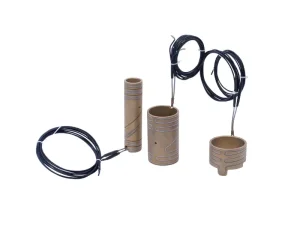
Featured Cast-In & Thermal Processing Solutions
Explore our top-tier industrial electric heaters, engineered for precision, high thermal efficiency, and minimal energy loss across global extrusion and processing lines.






Defining Next-Generation Finned Cast-In Heating Engineering
As global industrial thermal processes transition toward zero-carbon goals and extreme temperature precision, finned cast-in heaters represent the gold standard in combined conductive heating and convective air-cooling.
Traditional electric heating bands suffer from localized hot-spots, high radiant heat loss to the ambient factory floor, and delayed thermal response during forced air cooling cycles. Finned Cast-In Heaters overcome these constraints by integrating tubular heating elements directly into cast metal alloys (Aluminum A356, Brass, or Bronze) engineered with extended outer surface fins. This structure dramatically increases convective surface area, allowing high-efficiency cooling shrouds to stabilize temperature profiles during exothermic resin reactions in extrusion barrels.
Advanced Materials & Convective Heat Transfer Architecture
Selecting the right cast-in alloy and fin topology determines machine uptime, energy consumption, and thermal uniformity.
Widely recognized for high thermal conductivity (~160 W/m·K) and low mass. Operating temperatures up to 350°C (662°F). Ideal for standard plastics extrusion, blow molding, and fast thermal cycling environments.
- Optimal Watt Density: 20-35 W/in²
- Low thermal inertia for fast PID control response
- Cast in gravity die molds for void-free density
Engineered for extreme operating temperatures up to 650°C - 700°C (1200°F). Bronze cast-in heaters deliver superior mechanical strength, corrosion resistance, and high resistance to aggressive polymer off-gassing.
- Optimal Watt Density: 40-60 W/in²
- High structural integrity under mechanical shock
- Exceptional resistance to barrel wear and deformation
The exterior fins increase effective heat dissipation area by 150% to 230% compared to smooth cast bands. Combined with forced-air cooling blowers, this prevents polymer degradation from shear-induced heat build-up.
- Integrated cooling channels & shrouds
- Calculated fin pitch to avoid boundary layer turbulence
- Uniform radial temperature profile within ±1.5°C
Global Enterprise Procurement Trends & Supply Chain Needs
Industrial OEM manufacturers and processing plants across North America, Europe, and Asia-Pacific demand suppliers who balance strict tolerance control, international compliance, and optimized Total Cost of Ownership (TCO).
Unplanned machine downtime caused by premature heater element burnout costs enterprise processors thousands of dollars per hour. Premium finned cast-in heaters utilize high-grade 80/20 Ni-Cr resistance wire encased in compacted MgO insulation, guaranteeing operational lifespans exceeding 50,000 continuous hours.
Global extrude machine OEMs require exact dimensional matching for barrel diameters, thermocouple wells, cut-outs, and clamping bolts. Advanced factories employ 3D CAD modeling and CNC post-casting machining to maintain tight inner-diameter tolerances (±0.05 mm).
Energy efficiency regulation in the EU and North America forces factories to minimize thermal waste. Finned cast-in heaters paired with custom insulation jackets cut power consumption by up to 25-30% across large-scale extrusion lines.
Industrial Deployment Matrix & Sector Performance
From high-speed film blowing to specialized medical tubing extrusion, our finned cast-in heating assemblies deliver tailored thermal performance.
In twin-screw and single-screw extruders processing PVC, PE, PP, and engineering resins (PEEK, Fluoropolymers), precise cooling-heating zones prevent polymer chain degradation. Finned cast-in heaters combined with forced air cooling shrouds ensure absolute temperature stability.
High-output container blow molding requires uniform heat around die heads and barrels. Cast aluminum finned heaters eliminate cold spots, guaranteeing consistent wall thickness and superior optical clarity in blown films.
High-purity bronze cast-in heaters operate flawlessly in vacuum chambers and cleanroom processing equipment, resisting outgassing and maintaining ultra-stable thermal gradients during wafer thermal cycles.
Industrial heat tracing and pipe heating manifolds utilize custom curved cast-in heating segments with cooling fins to regulate fluid viscosity without creating localized localized fluid scorching.
Extremely rugged cast brass finned heaters withstand continuous vibration and elevated pressure in rubber profile extrusion dies, delivering reliable heating day after day.
Sanitary-grade sealed cast aluminum heaters provide indirect thermal energy to sealing jaws and thermal forming dies, adhering to strict hygiene and washdown standards.
2026–2030 Engineering Roadmap: Smart & High-Density Thermal Systems
Leading the future of industrial electric heat through material science innovations, predictive IoT thermal monitoring, and additive casting technologies.
Integrating ceramic nano-emissivity coatings on cast fins to boost radiant-convective efficiency by an additional 18%, lowering skin temperatures and improving cooling velocity.
Direct embedding of fiber-optic temperature sensors and thermal stress gauge arrays inside the casting matrix for real-time predictive failure analysis and Industry 4.0 integration.
Utilizing computational fluid dynamics (CFD) and 3D sand printing to cast non-linear, micro-channel fins that maximize heat extraction while cutting air turbulence noise.
Industrial Heating Technology Comparison & Selection Criteria
Compare core mechanical parameters across standard heater types to choose the exact technical fit for your processing barrels.
| Heater Construction Type | Max Temp (°C) | Max Watt Density | Cooling Compatibility | Thermal Inertia | Mechanical Durability |
|---|---|---|---|---|---|
| Finned Cast-In Aluminum | 350°C (662°F) | 35 W/in² (5.4 W/cm²) | Excellent (Forced Air Blower Shroud) | Medium | Very High (Solid Cast) |
| Finned Cast-In Bronze / Brass | 650°C (1200°F) | 60 W/in² (9.3 W/cm²) | Excellent (Forced Air / Liquid Channels) | High | Extreme (Heavy Duty) |
| Standard Ceramic Band Heater | 500°C (930°F) | 45 W/in² (7.0 W/cm²) | Moderate (External Air Only) | Low | Moderate (Ceramic Tile Grid) |
| Mica Band Heater | 280°C (536°F) | 25 W/in² (3.8 W/cm²) | Poor (No Active Cooling) | Very Low | Light to Moderate |
| Liquid-Cooled Cast-In Alloy | 450°C (842°F) | 50 W/in² (7.7 W/cm²) | Superior (Internal Liquid Loop) | High | Extreme |
Rigorous Inspection Protocols & Global Certification Standards
Every finned cast-in heating assembly manufactured in our facility undergoes strict 100% factory verification before export dispatch.
To ensure zero internal porosity, air pockets, or pinholes inside the cast aluminum/bronze matrix. Void-free casting guarantees uniform heat transfer and prevents hot-spot resistance wire breakdown.
Each heater is subjected to high-voltage dielectric breakdown testing (1500V - 2500V AC) and cold/hot insulation resistance checks (>500MΩ at 500V DC) to fulfill CE, UL, and RoHS directives.
During full-power burn-in tests, thermal imaging cameras verify uniform surface heat distribution across both the inner clamping radius and exterior cooling fins before approval.
Frequently Asked Questions (Q&A)
Comprehensive technical answers addressing custom drawing creation, heat calculations, export procedures, and thermal maintenance.
Industrial Heating Elements & Thermal System Portfolio
Discover our comprehensive line of high-performance industrial band heaters, ovens, spring heaters, and specialized processing equipment.