
Engineered Electric Heating Elements & Precision Systems
Explore our industrial-grade, certified heating and thermal conversion components. Every unit is engineered with verified thermal watt density and tested under stringent load metrics.

Best Infrared Ceramic Heaters for Efficient Heating Manufacturers, Exporters
View Specifications →
Best Efficient Portable Ceramic Heaters from China Suppliers - Ideal for Industrial Heating in Factories
View Specifications →
China Safe and Durable Mica Heaters Factory, Factories
View Specifications →
CE Certification Nano infrared electric band heater Manufacturer, Manufacturers
View Specifications →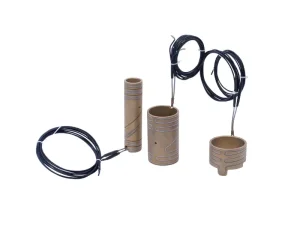
High-Quality (Hot-runner)Spring heater/Coil heater Manufacturers, Factory
View Specifications →
Best Durable Heat Insulation Covers Manufacturer, Exporters
View Specifications →
CE Certification Cast Aluminum/Copper Heater Manufacturer, Exporter
View Specifications →
China Portable Ceramic Heaters for Industry Manufacturers, Exporter
View Specifications →Industrial Heat Tape Solutions: Global Commercial & Plant Realities
From petrochemical pipeline freeze protection to extreme-temperature polymer processing, industrial heat tape (flexible trace heating) serves as an essential infrastructure asset ensuring process continuity and viscous fluid stability.
Severe Environment Engineering
Modern industrial facilities operate in environments ranging from arctic offshore installations at -50°C to high-viscosity asphalt transport lines exceeding 400°C. Our heat trace systems utilize braided fluoropolymer overjackets and nickel-chromium cores to resist aggressive hydrocarbons, mechanical abrasion, and moisture penetration.
Energy Decarbonization Pressures
Global carbon neutrality initiatives require industrial operations to cut parasitic thermal losses. Traditional steam tracing experiences up to 40% distribution loss. Transitioning to self-regulating or mineral-insulated electric heat tape coupled with automated algorithmic controls delivers up to 68% energy savings across extended pipeline networks.
TCO Reduction & Zero Downtime
Unplanned pipeline freeze-ups or solidification of heavy crude, sulfur, or resins cost industrial facilities tens of thousands of dollars per hour. Standardizing on factory-certified heat tapes with high dielectric isolation and robust mechanical termination systems virtually eliminates cold-spot failures and reduces operational maintenance lifecycles.
Industrial Heat Tape & Thermal Tracing Comparison Matrix
Selecting the correct heating tape architecture is governed by maximum exposure temperature, chemical exposure, electrical circuit length, and precise watt-density thresholds.
| Heat Tape Technology | Max Maintenance Temp | Max Exposure Temp | Typical Sheath Construction | Key Industrial Application Scenario |
|---|---|---|---|---|
| Self-Regulating (SR) Heat Tape | 65°C to 150°C (149°F - 302°F) | 85°C to 215°C (185°F - 419°F) | Cross-linked polyolefin or Fluoropolymer | Freeze protection, water lines, moderate process temp maintenance. Cannot overheat when overlapped. |
| Constant Wattage Heat Tape | 150°C to 200°C (302°F - 392°F) | 260°C (500°F) | Silicone rubber jacket with tinned copper braid | Long circuit runs, oil transport piping, process viscosity maintenance requiring uniform heat output. |
| Mineral-Insulated (MI) Cable Tape | 500°C to 600°C (932°F - 1112°F) | 650°C to 1000°C (1202°F - 1832°F) | Alloy 825, Stainless Steel 316, or Inconel | Refineries, bitumen plants, extreme-temperature chemical reactors, high-pressure steam tracing replacement. |
| High-Temp Knitted Fiberglass Tape | 400°C to 450°C (752°F - 842°F) | 500°C (932°F) | Multi-strand heavy fiberglass or ceramic braid | Laboratory glass reactors, pilot plant piping, hot-runner manifold systems, non-moisture environments. |
| Silicone Rubber Flexible Heat Tape | 200°C to 232°C (392°F - 450°F) | 260°C (500°F) | Vulcanized silicone rubber reinforced with fiberglass | Valves, pumps, complex irregular tooling, freeze protection of heavy equipment, outdoor moisture-prone tanks. |
Localized Applications & Global Compliance Guarantees
Industrial thermal components deployed worldwide must meet localized safety regulations, electrical isolation standards, and explosion-proof certifications for hazardous operating zones.
ATEX & IECEx Hazardous Areas
For installations in Zone 1 / Zone 2 environments (chemical processing, LNG terminals, and offshore rigs), our industrial heat tapes are engineered with conductive cores, tinned copper grounding braids, and electrostatic-dissipative sheaths complying with IEC/EN 60079 series standards.
CE, UL & CSA Validation
Every batch of heating tape, ceramic band, and cast-in heater conforms to low-voltage and electromagnetic compatibility directives. We supply test documentation verifying dielectric breakdown strength (>2000V), insulation resistance under humidity (>100MΩ), and flame-retardant casing properties.
Local Engineering Support
Through our dedicated technical services hub and established global distributors across 100+ countries, we deliver customized circuit sizing, heat-loss calculations using proprietary thermal modelling algorithms, and rapid sample prototyping backed by factory-trained field specialists.
Traceable Batch Quality Control
In accordance with Kangpu's 5-Year After-Sales Warranty, every individual roll of heating tape and cast heater receives an etched serial ID tracking core raw materials, conductor extrusion lots, vulcanization temperatures, and post-cure load cycle results.
7-Stage Strict Engineering Customization Workflow
From custom heat tape length and watt-density profiling to extruder heating/cooling integration, we eliminate trial-and-error risks before committing to mass production.
Design & Customization
Our thermal calculation engineers review your dimensional blueprints, chemical exposure profile, and operational delta-T. We determine exact watt density, sheath metallurgy, terminal box placement, and circuit protection thresholds.
Real-Mold Tooling & Customer Fit
Unlike competitors who supply makeshift hand-crafted prototypes, Kangpu develops real production tooling for the initial sample. This ensures the physical fit, clamping tightness, and heat conductivity precisely reflect final production realities.
Revision & Laboratory Testing
Customer feedback on lead exit angles, mounting clearance, and terminal enclosures is factored into sample modification. The final prototype undergoes Hi-Pot insulation breakdown testing, thermal equilibrium infrared scans, and cyclic fatigue stress checks.
Full-Scale Certified Production
Upon final prototype approval, high-speed automated extrusion lines, computer-controlled precision winding, and vulcanization chambers execute the mass manufacturing run. Every product undergoes 100% full-load inspection prior to bespoke shockproof packaging and global shipment dispatch.
Industrial Heat Tape Technology Roadmap (2026-2030)
As industrial automation shifts toward smart factories, predictive maintenance, and extreme energy conservation, Kangpu's R&D center focuses on the next generation of intelligent thermal materials.
IoT-Embedded Thermal Sensors
Integrating distributed micro-RTD and fiber-optic Bragg grating sensors directly into flexible heat tape structures to provide real-time, millimeter-accurate temperature feedback along pipeline runs.
Graphene Matrix Conductors
Formulating conductive polymer cores infused with carbon nanotubes and graphene to achieve ultra-fast thermal response times and maintain high PTC stability under continuous 250°C operating conditions.
Predictive Fault Detection
Developing AI-driven cloud gateways that detect micro-fluctuations in trace heater leakage currents and impedance, alerting plant engineers to mechanical insulation degradation weeks before thermal failure occurs.
Zero-Emission Composite Tracing
Deploying ultra-high-efficiency induction heating tapes and nano-aerogel integrated jackets that eliminate external radiant thermal losses, accelerating industrial carbon-neutral retrofit programs.
Frequently Asked Questions on Industrial Heat Tape & Thermal Systems
Expert answers addressing system sizing, overlap safety, voltage options, and maintenance protocols for plant managers and procurement engineers.
Can industrial heat tape be overlapped during pipeline installation?
It depends entirely on the heating cable technology. Self-Regulating (SR) heat tape can be safely overlapped because its carbon-polymer core automatically reduces local power output as temperature climbs, preventing hot spots. However, Constant Wattage or Mineral Insulated (MI) tapes must NEVER be overlapped; crossing them causes localized heat accumulation that will burn out the inner insulation and create a fire hazard.
How do you calculate the required wattage for heat tracing systems?
Required thermal wattage is calculated using the formula: Q = 2πk × (Tp - Ta) / ln(Do/Di) × Safety Factor (typically 1.25), where k is insulation thermal conductivity, Tp is maintained process temperature, Ta is minimum ambient temperature, and Do/Di are outer/inner insulation diameters. Our engineering team provides complimentary software-calculated heat-loss reports tailored to your pipe diameters, insulation thickness, and wind speed variables.
What makes Kangpu's 5-Year Warranty viable compared to typical 1-year terms?
Kangpu Heater (Yancheng Laier Heating Technology) maintains complete vertically integrated control over core element fabrication, silicone vulcanization, ceramic sintering, and terminal casting. By implementing batch traceability and testing 100% of finished goods under simulated load and dielectric stresses before export, our field failure rate remains below 0.04%, allowing us to back our components with an industry-leading 5-year warranty.
Which is preferable for plastics extruders: Ceramic band heaters or cast-in heaters?
Ceramic band heaters feature insulating ceramic segments that direct heat inward to the barrel while lowering exterior surface temperatures, making them highly cost-effective and energy-efficient for standard injection and extrusion lines up to 500°C. Cast Aluminum/Copper heaters encase heating elements inside solid conductive metal with integrated cooling tubes, providing superior structural durability and tight temperature control for high-output, continuous extrusion processes.
Can heat tape be cut to length in the field during installation?
Parallel-circuit self-regulating heat tapes can be cut to length on-site to accommodate unexpected piping geometry and valve configurations. Conversely, series-resistance constant wattage cables and mineral-insulated (MI) units are factory-manufactured to specific circuit lengths; cutting them alters overall circuit resistance, resulting in improper heat dissipation or immediate heater failure.
How do you guarantee prompt sampling and lead times for global projects?
Our facility houses dedicated tooling workshops and standard stock of resistance alloys, high-purity MgO, mica cores, and silicone extrusion matrices. Standard custom samples are engineered and dispatched within 5 to 7 business days, while volume OEM orders are typically fulfilled in 2 to 3 weeks, supported by comprehensive export documentation and global air/ocean freight coordination.
Specialized Industrial Heaters & Thermal Processing Units
Complete your facility's heating infrastructure with our high-output electromagnetic units, heating/cooling systems, and pipeline process heaters manufactured to international export standards.

Best Heating/Cooling Integrated System Exporter, Exporters
View Specifications →
China Efficient Portable Ceramic Heaters for Industry | China Suppliers & Factory Exporters
View Specifications →
CE Certification Electromagnetic induction heater Manufacturer, Exporter
View Specifications →
High-Quality Portable Ceramic Heaters for Industry - Reliable Heating Solutions from China Suppliers
View Specifications →
Best Pipeline Heater Manufacturers, Factory
View Specifications →
High-Quality Portable Ceramic Heaters for Industry - Efficient Heating Solutions Exporter
View Specifications →
CE Certification PVC-O Ovens for Precision Heating Manufacturer, Manufacturers
View Specifications →
High-Quality Portable Ceramic Heaters for Industry - Reliable Temperature Control Factory
View Specifications →Need Custom Industrial Heat Tape Sizing or an OEM Prototype?
Speak directly with our senior thermal engineers. Send your mechanical blueprints, operating temperatures, and electrical parameters for verified thermal analysis and quotation.