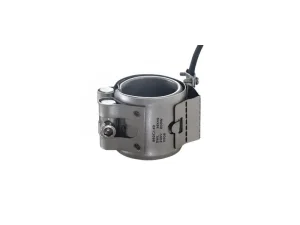
Primary Immersion & High-Performance Process Heaters
Explore our foundational range of CE-marked industrial thermal units, engineered with batch traceability, high dielectric strength, and precision-matched watt densities.





Industrial Dynamics & Global Procurement Trends
A transition from conventional thermal resistance towards intelligent, high-density immersion solutions driven by the EU Green Deal and corporate decarbonization mandates.
Decarbonization & Direct Electrification
Global industrial hubs are accelerating the phase-out of fossil-fuel combustion boilers. Flanged immersion heaters and circulation heaters provide direct 99%+ thermal conversion efficiency with zero local carbon emissions, aligning with ISO 50001 energy standards.
IoT-Integrated Thermal Monitoring
Modern process plants demand embedded RTD or Type-K thermocouples inside thermowells within the heating bundle. This prevents localized sheath overheating, mitigates scaling degradation, and feeds real-time health data to distributed control systems (DCS).
Advanced Metallurgy for Corrosive Media
Procurement departments require rigorous alloy matching: Incoloy 800/840 for severe oxidation resistance, Titanium sheathing for electroplating baths, and 316L Stainless Steel with electropolished finishes for chemical and sanitary applications.
China Industry 4.0: Supply Chain Resilience & Manufacturing Depth
Operating as Yancheng Laier Heating Technology Co., Ltd. (Kangpu Heater) since 1986, we bridge engineering expertise with smart manufacturing to guarantee low total cost of ownership (TCO).
Automated Coil Winding & Filling
Computer-controlled high-speed winding of NiCr 80/20 resistance coils combined with pneumatic high-frequency MgO compaction ensures unvarying dielectric properties across runs.
CE, LVD & EMC Protocol Compliance
Every element is engineered to satisfy EU Low Voltage Directive (2014/35/EU) and Pressure Equipment Directive (PED 2014/68/EU) parameters, ensuring smooth customs release and terminal safety.
Aggregated Cluster Advantages
Located in Yancheng, Jiangsu, our direct access to raw electrical-grade MgO, seamless stainless tubes, and specialized casting foundries shortens production cycles by up to 40%.
Rigorous 7-Stage Validation
From 3D solid CAD modeling to sample tooling, insulation resistance stress tests, and real-mold verification, production begins solely after customer sign-off.
Localized Application Matrix & Engineering Scenarios
Immersion heating dynamics require strict adaptation to viscosity, flow rate, and heat-transfer limits. Here is how our engineering matrix resolves field conditions:
| Industrial Process | Common Fluid / Medium | Watt Density Window | Recommended Sheath & Sealing | Key Operational Challenge Solved |
|---|---|---|---|---|
| Thermal Oil Circulation | Mineral or synthetic heat transfer fluid | 1.5 – 2.5 W/cm² (10–16 W/in²) | Incoloy 800 / SS321 with Viton O-rings | Prevents fluid cracking and carbon build-up on the sheath surface. |
| Industrial Water Heating | Demineralized, DI, or clean process water | 6.0 – 10.0 W/cm² (40–65 W/in²) | AISI 304 / 316L, TIG welded to ANSI flange | Maximizes rapid thermal transfer without sheath cavitation or corrosion. |
| Corrosive Acid / Alkaline Baths | Phosphating liquids, plating chemicals | 2.0 – 4.0 W/cm² (13–26 W/in²) | Titanium or PTFE Teflon-sleeved elements | Provides chemical resistance against severe pitting and metal erosion. |
| Viscous Heavy Oils & Asphalt | Bunker C, crude, heavy fuel bitumen | 0.8 – 1.2 W/cm² (5–8 W/in²) | Heavy-wall SS304 inside replaceable thermowells | Avoids localized coking while allowing element replacement without draining tanks. |
| Plastics Extrusion & Polymer Melting | Thermoplastic resins, PVC compound | 3.0 – 6.5 W/cm² (Custom mapped) | Cast Aluminum/Copper with cooling jackets | Maintains tight zone tolerances, preventing thermal overshoot in the melt stream. |
Technical FAQ: Engineering & Procurement Insights
Direct responses from our engineering department regarding installation safety, thermal life cycles, and CE certification parameters.
Advanced Thermal Systems, Induction & Auxiliary Line
Complementary thermal technologies engineered for plastics processing lines, energy-saving retrofits, and high-efficiency fluid heating installations.