
Precision Industrial Thermal Assemblies & Heating Elements
Engineered by Kangpu Heater (Yancheng Laier Heating Technology Co., Ltd. Est. 1986). Direct export to 100+ nations with a 5-year traceable warranty.








Engineering Semantics: Demystifying "Infrared vs. Radiant" Heating
A rigorous examination of Stefan-Boltzmann radiation, Planck's distribution laws, and the technical boundaries separating electromagnetic infrared emitters from broad-spectrum radiant systems.
1. The Physical Continuum: All Infrared is Radiant, But Not All Radiant is Targeted Infrared
In industrial thermal engineering, the semantic distinction between an "Infrared Heater" and a "Radiant Heater" is often obscured by marketing colloquialisms. From a first-principles thermodynamic perspective governed by Maxwell's electromagnetic equations, thermal radiation constitutes the emission of electromagnetic waves from all matter possessing a temperature above absolute zero (0 Kelvin). The rate of emission is dictated by the Stefan-Boltzmann law ($E = \varepsilon \sigma T^4$).
However, when industrial procurement teams, extruder designers, and plant engineers solicit an infrared vs. radiant heater exporter, they are actively addressing fundamental operational parameters: spectral wavelength tuning, penetration depth versus surface absorption, thermal inertia, and directional radiative efficiency.
This mechanistic difference drives substantial variance in factory energy consumption. In plastics extrusion processing, utilizing untuned radiant surfaces results in up to 35% parasitic heat loss via natural convective drafting into the workshop floor. By contrast, deploying precision-targeted Nano Infrared Electric Band Heaters shielded by multi-layered aerogel reflective insulation concentrates electromagnetic flux directly perpendicular into the barrel cylinder, converting up to 99.2% of electrical input into effective thermal work.
| Thermal Characteristic | Targeted Infrared Heating Systems | Conventional Industrial Radiant Heaters | Kangpu Hybridized Engineering Advantage |
|---|---|---|---|
| Primary Electromagnetic Band | Short to Medium-Wave IR ($0.78\,\mu\text{m} - 3.5\,\mu\text{m}$) | Long-Wave IR & Far-IR ($4.0\,\mu\text{m} - 100\,\mu\text{m}$) | Dual-band targeted spectral output matched to resin absorption resonance |
| Thermal Rise & Ramp Velocity | Instantaneous to rapid (1 to 15 seconds) | Moderate to slow (5 to 30 minutes) | 35% faster cold start on extrusion and molding lines |
| Energy Transfer Efficiency | Direct molecular resonance, minimal air heating | Coupled conduction-radiation with convective bypass | Up to 30% - 45% power consumption reduction via nano-insulation barrier |
| Surface Operating Temperature | Emitter operates at $800^\circ\text{C} - 2200^\circ\text{C}$ inside sealed core | Sheath operates at $250^\circ\text{C} - 650^\circ\text{C}$ | Cold-touch exterior casing ($<45^\circ\text{C}$) ensuring supreme worker safety |
| Precision Temperature Control | High response to SCR / Thyristor phase-angle fired controllers | Higher thermal mass requiring continuous PID stabilization | Patented zone heating/cooling integration preventing melt temperature overshoot |
| Structural Ruggedness & Vibration | Quartz/Ceramic encased elements; requires shock dampening | Extremely robust cast-iron, cast-aluminum, or solid mica core | Die-cast alloy housings + reinforced spring clamping against heavy machinery shock |
The Chinese Factory Advantage: Why Global OEMs Rely on Yancheng Engineering
From the heart of China's premier industrial heating manufacturing cluster in Yancheng, Jiangsu, Kangpu Heater integrates raw metallurgy, precision CNC tooling, and stringent quality control protocols.
Full Supply Chain Integration
Unlike regional assemblers or trading middle-men, Yancheng Laier controls raw material procurement from primary high-temperature resistance alloy ingots (Cr20Ni80, Kanthal AF) to electro-grade crystalline MgO insulation powder and high-purity steatite ceramics. This vertical integration guarantees batch-to-batch chemical uniformity and eliminates raw material supply chain disruptions.
Dedicated Real-Mold Tooling
We reject generic manual approximations. Our production line deploys a strict 7-stage customization protocol: following 3D CAD/SolidWorks validation, real production molds are fabricated in-house. Even initial sample approval units reflect actual mass-production casting, extrusion, or stamping tolerances, ensuring zero dimensional deviations on automated OEM lines.
5-Year Traceable Warranty
While industry standard warranties for heating elements linger between 6 and 12 months, Kangpu guarantees its industrial heating series with a comprehensive 5-year after-sales framework. Every single heater is laser-etched with a serialized matrix linking it to the specific operator, winding batch, insulation powder lot, and automated flash-over leakage test reports.
Direct Engineer-to-Buyer Synergy
We operate as a high-precision manufacturing lab run by thermal engineers, not an opportunistic export trading company. When global buyers communicate machine specifications, our technical team evaluates watt-density boundaries, thermal expansion friction, lead wire vibration resistance, and clamping torque to prevent early in-field failure modes.
Global Technological Trajectories in Process Thermal Management
Examining the worldwide shift toward industrial decarbonization, smart IoT-enabled thermal feedback, and high-efficiency hybrid heating/cooling architectures.
Electrification & Fossil Fuel Phase-Out in Industrial Process Heat
Across Europe, North America, and high-tier Asia-Pacific manufacturing hubs, industrial operators are aggressively displacing fossil-fuel-fired thermal fluid systems, natural gas burners, and obsolete low-efficiency boiler systems. Regulatory carbon taxation frameworks and ESG compliance mandates have pushed electric heating systems to the forefront of plant modernization.
Kangpu's Electromagnetic Steam Boilers and High-Efficiency Pipeline Circulation Heaters represent the apex of this paradigm shift. Utilizing high-frequency electromagnetic induction, these units generate pure, instantaneous process steam and high-temperature thermal fluids with near-unity conversion efficiency, completely eliminating on-site NOx, SOx, and greenhouse emissions, while drastically reducing maintenance costs associated with open-combustion burners.
Advanced Nano-Aerogel Hybridization & Closed-Loop Thermal Dynamics
The historical vulnerability of high-temperature band heaters was exterior radiation loss. When an extruder barrel operates at $300^\circ\text{C}$, untamed convection and long-wave radiant dispersion can turn factory floors into inhospitable microclimates, overburdening HVAC chillers and escalating kilowatt-hour consumption. In our latest generation of Nano Infrared Electric Band Heaters, Kangpu combines aerospace-grade microporous aerogel matrices with silicon-carbide reflective mirrors.
This retains up to 98% of radiative energy inside the active processing zone, ensuring that the external stainless steel shell remains cool to the touch ($35^\circ\text{C} - 48^\circ\text{C}$). Concurrently, the integration of patented blower cooling channels, cast copper fluid jackets, and embedded dual J/K-type thermocouple wells provides closed-loop algorithmic PID control capable of dampening thermal overshoot within $\pm0.5^\circ\text{C}$ across high-shear extrusion polymer flows.
STAGE 01 - 02
Application Modeling & Customization
Thermal loading calculations, barrel dimensional verification, voltage matching (110V - 690V), watt-density optimization ($2.5 - 9.0\,W/cm^2$), and terminal geometry configuration.
STAGE 03 - 04
Real-Mold Tooling & Prototype Sampling
Precision CNC steel tooling, die-casting, automated coil winding, real-mold sample fabrication, and client assembly fitment validation on actual production equipment.
STAGE 05 - 07
Testing, Certification & Volume Export
Hi-pot dielectric breakdown resistance testing (>2000V/1min), insulation impedance verification (>50MΩ), thermal cycling validation, CE/RoHS compliance, and mass dispatch.
Engineered Deployment Scenarios Across Global Heavy Industry
Explore where Kangpu's infrared and radiant heating systems deliver mission-critical thermal reliability every single day.
Plastics Extrusion & Blow Molding
Twin-screw extruders processing heat-sensitive polymers (CPVC, PVDF, EVOH, Bio-resins) demand absolute thermal linearity. Our cast-in aluminum/copper heaters paired with aerogel insulation jackets eliminate localized hot-spots and degradation shear banding, extending screw life and ensuring pristine melt homogeny.
Biaxially Oriented PVC-O Pipe Ovens
Molecularly oriented PVC-O pipes provide double the tensile strength and impact resistance of standard PVC-U with reduced material thickness. Achieving reliable molecular stretching requires precise infrared radiant conditioning ovens capable of soaking the pipe preform to exact target crystallization temperatures within narrow margins.
Semiconductor & Cleanroom Curing
Eliminating contamination is mandatory. Kangpu’s specialized electromagnetic steam systems, quartz tube heaters, and polished stainless steel air duct heaters provide non-contact, zero-particulate radiative heat suited for wafer drying, photoresist curing, and lithium-ion battery electrode foil drying tunnels.
Automotive Thermoforming & Composites
Short-wave and medium-wave infrared emitter banks provide hyper-rapid radiant heating for carbon-fiber prepregs, acoustic automotive headliners, and interior dashboards. Deep-penetrating radiant flux plasticizes thermoplastic sheets in seconds without burning surface decorative skins.
Chemical, Fluid & Heavy Crude Pipelines
Flanged inline electric circulation heaters and explosion-proof pipeline heaters maintain critical fluid viscosity for petrochemical processing, thermal oil loops, asphalt transport, and marine bunker fuel heating with multi-zone digital safety cut-offs.
High-Density Hot-Runner Tooling
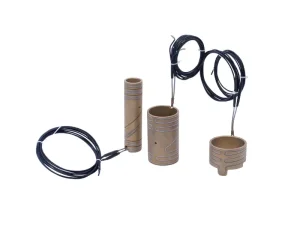
High-cavitation injection molds rely on Kangpu’s precision spring coil and nozzle band heaters. Engineered with nickel-chromium resistance wire tightly wound in mineral-insulated matrices, they deliver high watt densities directly to runner manifolds, preventing nozzle freeze-off.
Advanced Thermal Induction, Process Furnaces & Heavy Systems
Certified industrial machinery heating elements, industrial steam generators, and integrated extrusion cooling systems engineered for demanding factory environments.






Frequently Asked Questions on Infrared & Radiant Heating Procurement
Authoritative answers addressing engineering parameters, customized builds, thermodynamic design choices, and export terms.
How do I determine whether my process requires an Infrared Band Heater or a Ceramic Radiant Band Heater?
- Choose Ceramic Radiant Band Heaters when your process relies on heavy conductive and steady-state thermal soaking across massive metal barrels, such as continuous profile extrusion or compounding lines where process temperatures range between $250^\circ\text{C}$ and $500^\circ\text{C}$. Ceramic bands feature built-in insulating blocks that retain heat well against moderate ambient drafting.
- Choose Nano Infrared Band Heaters when your facility targets strict energy conservation (saving 30% to 45% electricity compared to traditional bands), requires ultra-rapid cold starts, or operates in air-conditioned environments where external radiant heat emission must be minimized. The nano-aerogel insulation and reflective core drive electromagnetic infrared flux directly into the barrel while keeping the outer shell cold to the touch ($<45^\circ\text{C}$).
What specific drawing details and technical data are required to initiate custom fabrication at Kangpu?
- Geometric Dimensions: Internal Diameter (ID), axial length/width, and minimum wall thickness tolerances.
- Electrical Specifications: Input voltage (single or three-phase from 110V up to 690V), total wattage, and desired watt-density ($W/cm^2$).
- Clamping & Mounting: Clamping style (barrel latch, bent-up flange, wedge lock, or spring-loaded retention to accommodate barrel thermal expansion).
- Cutouts & Clearance: Diameter and precise XY coordinates for thermocouple wells, pressure transducer holes, or barrel venting ports.
- Terminations & Leads: Screw terminals, ceramic junction blocks, European plugs, high-temp armored stainless steel braided leads, or explosion-proof terminal enclosures.
Why does Kangpu Heater offer a 5-Year Warranty while most competitors limit coverage to 12 months?
- We utilize high-grade Nichrome (Cr20Ni80) resistance wire with optimal grain boundaries.
- MgO insulation is compressed via high-tonnage swaging machines to maximize thermal conductivity away from the core wire, keeping wire operating temperatures low.
- Every finished unit undergoes strict 2,500V dielectric hi-pot testing, insulation resistance screening (>100 MΩ), and serialized barcode batch tracking. Our warranty reflects structural engineering integrity, not marketing optimism.
Can Kangpu retrofit legacy extruder barrels with modern Heating/Cooling Integrated Systems?
What export compliance certifications and quality protocols apply to Kangpu industrial heaters?
What is the maximum permissible watt density for cast copper vs. cast aluminum vs. mica heaters?
- Mica Band Heaters: Recommended up to $3.5 - 4.5\,W/cm^2$; maximum sheath temperature $\sim350^\circ\text{C}$. Best for injection molding nozzles and light barrels.
- Cast Aluminum Heaters: Recommended up to $4.0 - 5.5\,W/cm^2$; maximum operating temperature $380^\circ\text{C} - 400^\circ\text{C}$. High durability, uniform heat.
- Cast Bronze / Copper Heaters: Recommended up to $6.5 - 8.5\,W/cm^2$; operating temperatures reach up to $650^\circ\text{C} - 700^\circ\text{C}$. Ideal for high-temperature engineering plastics (PEEK, PTFE, PPS).
- Ceramic Knuckle Bands: Recommended up to $6.0 - 8.0\,W/cm^2$; operating temperatures reach $650^\circ\text{C}$.